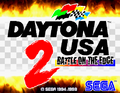
Daytona USA 2: Battle on the Edge
From Sega Retro
| Daytona USA 2: Battle on the Edge | |||||||||||||||||
|---|---|---|---|---|---|---|---|---|---|---|---|---|---|---|---|---|---|
| System(s): Sega Model 3 Step 2.1 | |||||||||||||||||
| Publisher: Sega | |||||||||||||||||
| Developer: Sega AM2 | |||||||||||||||||
| Supporting companies: Sega AM11 (art) | |||||||||||||||||
| Distributor: Deith Leisure (UK)[1] | |||||||||||||||||
| Genre: Racing | |||||||||||||||||
| Number of players: 1-16 | |||||||||||||||||
|

This short article is in need of work. You can help Sega Retro by adding to it.
Daytona USA 2: Battle on the Edge (DAYTONA USA 2 BATTLE ON THE EDGE) is a sequel to Daytona USA, released exclusively in arcades for Sega Model 3 Step 2.1 hardware in 1998.
Daytona USA 2 builds upon the formula seen in Daytona USA - it is a NASCAR-style racing game where the player drives a stock car across three different circuits, attempting to overtake other players and finish first. It was followed by an update, Daytona USA 2: Power Edition later in the year.
The game is an outlier in the Daytona USA series as it does not include the three levels from the original arcade game. However, it does allow the user to play as the "Hornet" stock car through a hidden cheat code. Though the Hornet team is still mentioned through advertisements on the tracks, Daytona USA 2 allows the player drive a new set of cars (there are three to choose from, each with their own pros and cons) around three completely new tracks which have not been seen in a Daytona USA game since.
Contents
Gameplay
From a gameplay perspective, little has changed between Daytona USA and Daytona USA 2, though there is a heavier emphasis on drifting this time around. The visuals and audio however, have been greatly improved to take advantage of the improved hardware.
Daytona USA had the ability for cars to be damaged, but it was limited to wobbling wheels and very basic deformation. Daytona USA 2 expands on this with paint scrapes, bonnets and fenders flying off, and smoke billowing from the engine after a large crash. On rare occasions the computer purposely causes two cars in front of the player to crash into each other to add extra challenge, and can in theory wipe every other car off the track. Similar to the original, AI movements are determined on how the player drives - if he/she is gentle, there is more chance of the AI causing carnage than if the player is seen as "aggressive".
As a whole, the AI has been improved over the original (as opposed to Scud Race which is largely the same), and movement is similar to the player's car (thus stopping erratic behavior sometimes witnessed in previous entries). Like Daytona USA the physics are not precise - there are six crash patterns in Daytona USA 2 which are triggered depending on the speed and angle of impact. Damage, however, is calculated properly, so dents will appear exactly where the car was hit.
Up to 16 cabinets may be linked together for multiplayer, up from 8 in the original "Daytona USA."
Tracks
| Astro Waterfall Speedway (beginner) | |
|---|---|
| The beginner track, Astro Waterfall Speedway, takes place within a large bio-dome, but is otherwise a circular track similar to the beginner track in Daytona USA. Like the original game, 40 cars are on the track and the aim is to overtake them all in 8 laps. This level is exclusive to Daytona USA 2: Battle on the Edge - Daytona USA 2: Power Edition removes the dome and turns it into a more standardized NASCAR race track.
If the player taps START just before the start/finish line, the "CHECK!" message will be replaced by a random phrase - one of them being "GO TO HELL!", bizzarely enough. The music played on this level is "Sling Shot", and is the only level of the three to have a rolling start. | |
| Joypolis 2020 Amusement Park (advanced) | |
| The advanced track, Joypolis 2020 Amusement Park, takes place within a theme park (named after the real-life Joypolis parks), making it one of the more peculiar tracks in the Daytona USA series. Cars travel through haunted house, space, lava and ice areas, as well as an outside segment where the track leads under a swinging pirate ship. 20 cars are on the track by default and the race lasts 4 laps.
During laps 3 and 4, if the player taps START as it enters the "Space Haneda" attraction, the flying spaceships will shoot the course, creating explosions and lighting the track. The music played here is "I Can Do It". | |
| Virtua City (expert) | |
| The expert track, Virtua City, takes place in and around a city reminiscent of New York (actually called "New Joke City"). There are only 2 laps by default, but 30 cars.
If the player holds START at the port area of the track, the propellers inside the shed will start spinning until the button is let go. "Skyscraper Sequence" is the name of the music track used in this level. |


History
Development
The Daytona USA 2 development team consisted of roughly half a dozen members from the previous Daytona USA along with some who had migrated from the Virtua Fighter 3 team at AM2. The Virtua Fighter 3 developers were said to lack knowledge and experience in developing driving games[4], but were particularly skilled in animating 3D models. Previous AM2 racing games lacked many humans or animals in-game, however this new skillset allowed Daytona USA 2 to have features such as a much more realistic pit crew (apparently all modeled by just one person, by hand)[4].
Very little was taken from the original Daytona USA during development - the game engine was re-built from scratch and the visuals and audio were completely new[5]. The game uses roughly five times as many polygons as the original[5].
The cars were modeled on the Chevrolet Monte Carlo, Ford Thunderbird and Pontiac Grand Prix though were tweaked to avoid licensing issues (there are also two types of enemy car which sport generic designs)[4]. The performances of the cars were made up - inspired by specialist magazines and books but not taken from the manufacturers themselves[4]. Like the original game, the player's car is given the number "41" - Toshihiro Nagoshi's "lucky number".
Much of the inspiration behind this game came from a team trip to Orlando, Florida, USA. The team traveled to the Daytona International Speedway and used shotgun microphones to record many of the sound effects[6]. The intermediate course is modeled on the likes of Walt Disney World and Universal Studios[6], while the shark at the start of the course is directly inspired by the Jaws ride[7]. The team also traveled to North Carolina for a race around a NASCAR track with a professional driver (where more sound effects were recorded) and to New York, where the expert track would be based on[7].
Director Makoto Osaki wanted to include an Egyptian-style course however it was said to be too similar to the Mystery Ruins track of Scud Race[7].
The Model 3 Step 2.1 hardware allowed the developers to utilize effects such as smoke, sparks and fire - a challenge to achieve in previous versions of the hardware.
Takenobu Mitsuyoshi would return to perform the vocals, however Dennis St. James was brought in to do the vocals of the western versions (though they both sing in English). There is an option for arcade operators to switch between the two.
Daytona USA 2: Battle on the Edge was officially announced by Toshihiro Nagoshi on April 16, 1998 at the Twin Ring Motegi race track in Japan[8], where reporters were given the chance to ride in in one of three NASCAR vehicles around the 1.5 mile oval track[9] (though only two were allowed on the track at any one time[8]). Twin Ring Motegi was built in 1997 and at this point had only hosted a single CART race in March 1998, however would host a NASCAR race for the first time in November.
Legacy
Daytona USA 2: Battle on the Edge would be followed by Daytona USA 2: Power Edition, which serves as an upgrade to this game. Battle on the Edge would see no home ports of its own, however the "Challenge" track from "Power Edition" is included as part of OutRun 2 for the Xbox.
The game was rumoured to be a launch title for the Sega Dreamcast (prior to the system being known as the Dreamcast) alongside entries in the Virtua Striker and Virtua Fighter series[10]. This did not come to pass, though a different Model 3 racer, Sega Rally 2 would later fill the spot, only to be delayed past the launch date by several weeks).
Production credits
- Main article: Daytona USA 2: Battle on the Edge/Production credits.
Digital manuals

US manual (standard)

US manual (deluxe)

US manual (twin)
US service bulletin 1
US service bulletin 2

US service bulletin 3
Magazine articles
- Main article: Daytona USA 2: Battle on the Edge/Magazine articles.
Promotional material
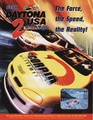
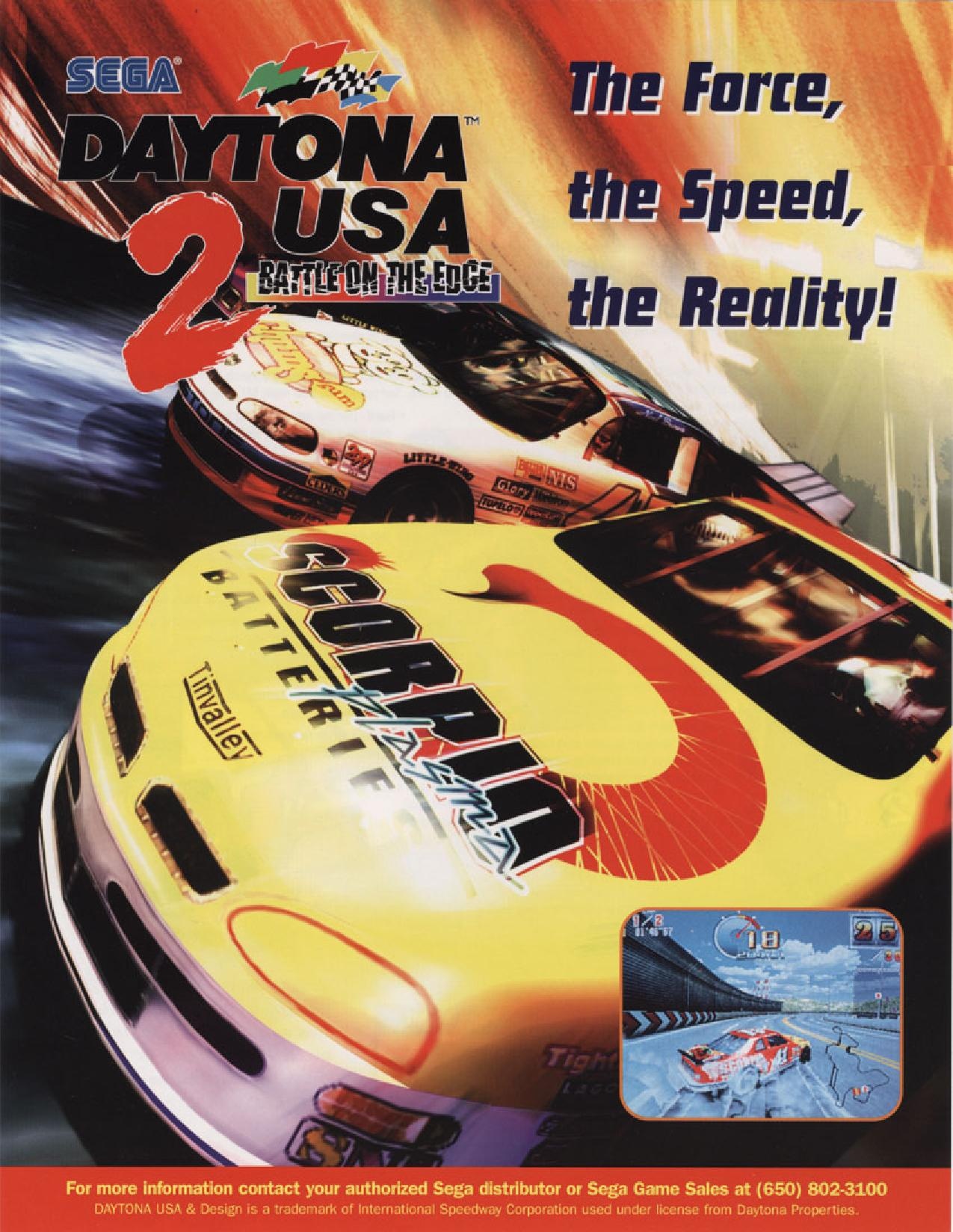
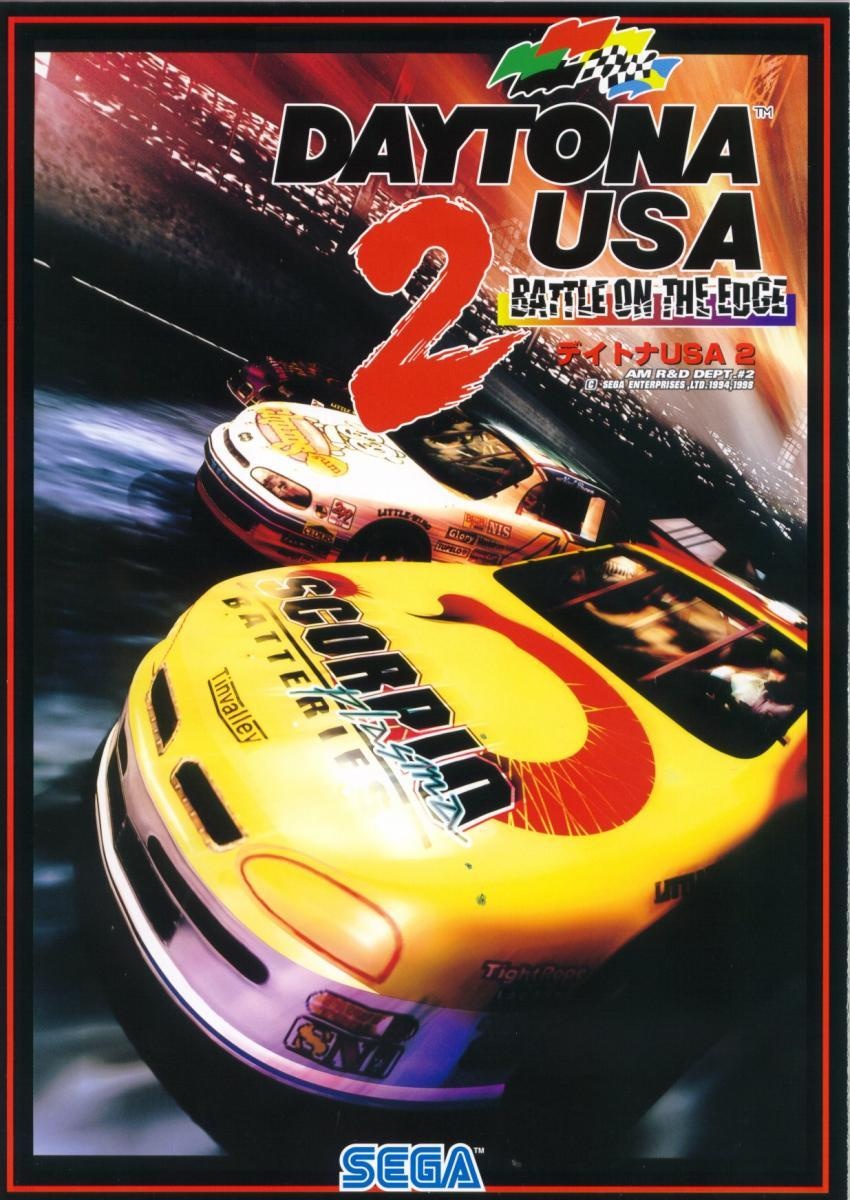
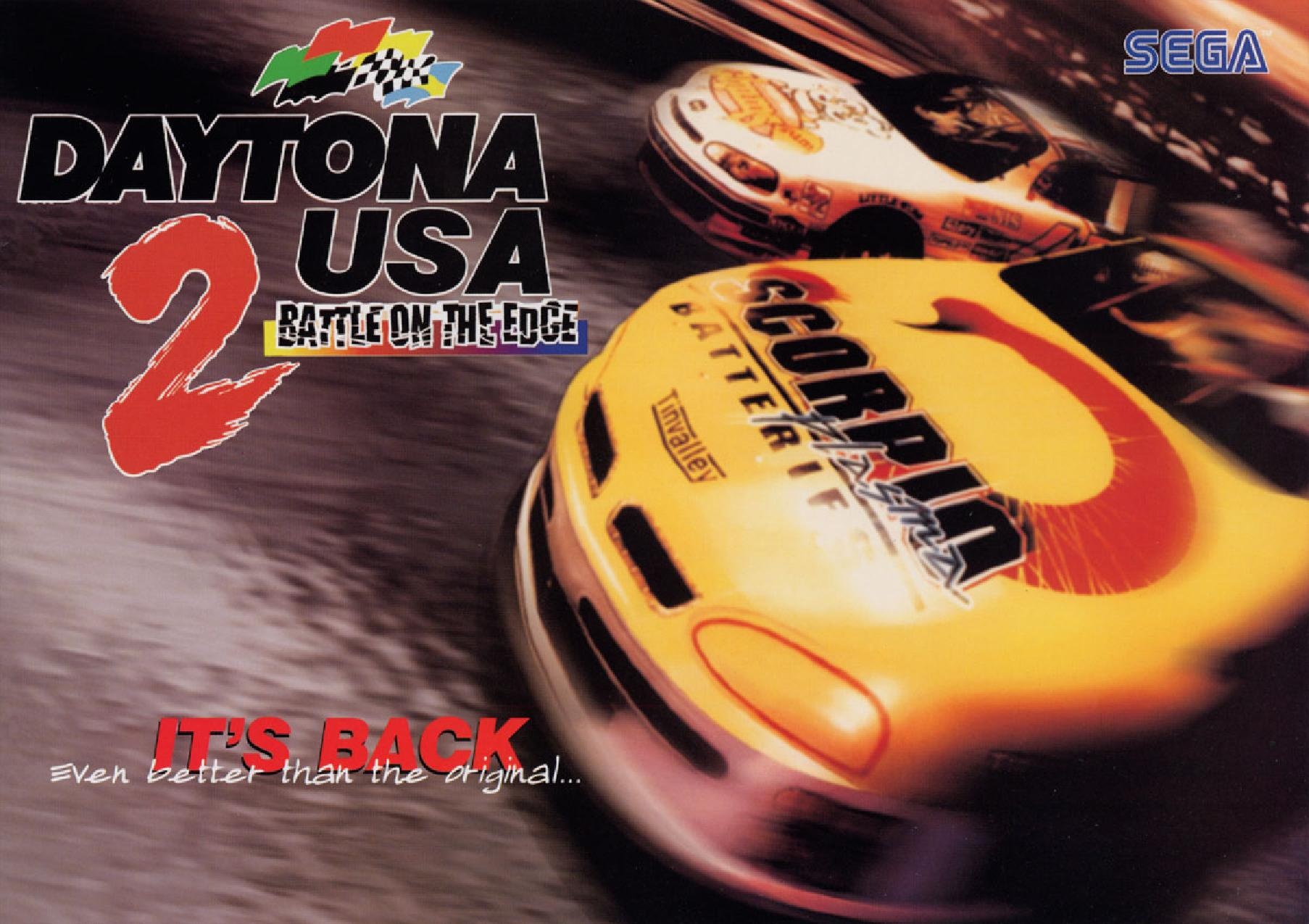
Photo gallery
Deluxe Cabinet
Twin Cabinet


Physical scans
| Sega Retro Average | |||||||||
|---|---|---|---|---|---|---|---|---|---|
|
 |
75 |
|---|---|
| Based on 1 review | |
| Model 3, US (deluxe | ||||
|---|---|---|---|---|
 Manual  Wiring diagram | ||||
| Model 3, US (twin) | ||||
|---|---|---|---|---|
 Wiring diagram | ||||
| Model 3, JP | ||||
|---|---|---|---|---|
| Model 3, UK | ||||
|---|---|---|---|---|
References
- ↑ 1.0 1.1 Computer & Video Games, "August 1998" (UK; 1998-07-15), page 78
- ↑ Sega Arcade History, Enterbrain, page 148
- ↑ Electronic Gaming Monthly, "October 1998" (US; 1998-0x-xx), page 202
- ↑ 4.0 4.1 4.2 4.3 Sega Saturn Magazine, "September 1998" (UK; 1998-08-12), page 25
- ↑ 5.0 5.1 Sega Saturn Magazine, "September 1998" (UK; 1998-08-12), page 26
- ↑ 6.0 6.1 Sega Saturn Magazine, "September 1998" (UK; 1998-08-12), page 27
- ↑ 7.0 7.1 7.2 Sega Saturn Magazine, "September 1998" (UK; 1998-08-12), page 28
- ↑ 8.0 8.1 Sega Saturn Magazine, "July 1998" (UK; 1998-06-17), page 49
- ↑ Gamers' Republic, "July 1998" (US; 1998-06-16), page 10
- ↑ Ultra Game Players, "January 1998" (US; 199x-xx-xx), page 20
- ↑ Next Generation, "September 1998" (US; 1998-08-18), page 146
| Daytona USA 2: Battle on the Edge | |
|---|---|
|
Main page | Comparisons | Credits | Hidden content | Magazine articles | Reception
Music: Daytona USA 2 Sound Tracks (1998) Videos: Daytona USA 2: Battle on the Edge (199x) | |