Dynamite Cop
From Sega Retro
| ||||||||||||||||||||||||||||||||||||||||||||||||||||||||||
| Dynamite Cop | ||||||||||||||||||||||||||||||||||||||||||||||||||||||||||
|---|---|---|---|---|---|---|---|---|---|---|---|---|---|---|---|---|---|---|---|---|---|---|---|---|---|---|---|---|---|---|---|---|---|---|---|---|---|---|---|---|---|---|---|---|---|---|---|---|---|---|---|---|---|---|---|---|---|---|
| System(s): Sega Model 2 (all three versions), Sega Dreamcast | ||||||||||||||||||||||||||||||||||||||||||||||||||||||||||
| Publisher: Sega | ||||||||||||||||||||||||||||||||||||||||||||||||||||||||||
| Developer: Sega of America Product Development Dept.[1], Sega AM1[2] | ||||||||||||||||||||||||||||||||||||||||||||||||||||||||||
Peripherals supported:  | ||||||||||||||||||||||||||||||||||||||||||||||||||||||||||
| Genre: Action[3][4][5] | ||||||||||||||||||||||||||||||||||||||||||||||||||||||||||
| Number of players: 1-2 | ||||||||||||||||||||||||||||||||||||||||||||||||||||||||||
|


.svg)

This short article is in need of work. You can help Sega Retro by adding to it.
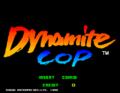
Dynamite Cop, known as Dynamite Deka 2 (ダイナマイト刑事2) in Japan, is a beat-'em-up game created by Sega AM1. It was released for all three versions of the Sega Model 2 arcade hardware in 1998 (the only game to run on all Model 2 boards) before subsequently being ported to the Sega Dreamcast the following year. It is a sequel to Die Hard Arcade (Dynamite Deka in Japan), though unlike its predecessor, lacks the Die Hard film license. It was soon followed up by Asian Dynamite.
Contents
Gameplay
Dynamite Cop is largely the same game as Die Hard Arcade, however instead of taking over a skyscraper, Wolf Hongo and his group of "modern day pirates" hijack a cruise liner and three protagonists are tasked with saving the president's daughter. Bruno Delinger returns but Cindy Holiday does not (in standard versions of the game at least), instead being replaced by two new characters, Jean Ivy and Eddie Brown, each with slightly different movesets to Bruno.
Primarily the biggest change in Dynamite Cop is the ability to face and attack in eight directions as opposed to only two. It is also less realistic than its predecessor, and the superior technical specifications of the Model 2 (and Dreamcast) hardware lead to higher quality graphics and sound.
Similar to Deep Scan's relationship with Die Hard Arcade, the Dreamcast version of Dynamite Cop includes the 1980 arcade game Tranquillizer Gun which can be used to give the player extra credits. The Dreamcast version can also be upgraded to "version 1.1" using a special save file, unlocking Cindy Holiday from the first game as a playable character.
History
Marketing
Unlike most arcade games of its time, Dynamite Cop was not revealed to the public at a trade show. Instead, fittingly based on the game's own setting, it was unveiled on April 20, 1998, on a cruise ship where many people from the gaming press were invited. Makoto Uchida attended the event cosplaying as protagonist Bruno Dillinger, although it wasn't too noticeable considering the character doesn't have the most distinct appearance, just wearing a jacket and carrying a gun. He enacted a scene with an AM1 programmer who was pressured into cosplaying as the President's daughter. This programmer's cross-dressing incident was the subject of a joke manga artist Ami Shibata made for Famitsu[15].
Legacy
Coolnet Entertainment planned to work with Sega to produce an Xbox port of the game (with extra characters)[16], but the port did not materialise.
Versions
Localised names
| Language | Localised Name | English Translation |
|---|---|---|
| English | Dynamite Cop | Dynamite Cop |
| English (US) | Dynamite Cop | Dynamite Cop |
| Japanese | ダイナマイト刑事2 | Dynamite Deka 2 |
Production credits
- Main article: Dynamite Cop/Production credits.
Arcade version
- Main Program Work: Tomoaki Takayanagi
- Enemy Program Work: Tomoyuki Naito
- Program Assist: Taro Fukunaga
- All 3D Environment Artwork: Takahiro Kudo
- All 3D Character Artwork: Hiroshi Kanazawa
- Special Effects: Shinichi Fujii, Kunio Watanabe
- 2D Art Work: Shinichi Fujii
- Main 3D Motion: Atsushi Saito, Makoto Uchida
- Additional 3D Motion: Takahiro Kudo, Atsushi Shimamura, Yasushi Sekido, Yuuki Suzuki, Shinichi Fujii
- Demo Scene Artwork: Takahiro Kudo, Hiroshi Kanazawa, Atsushi Saito, Makoto Uchida, Atsushi Shimamura, Yasushi Sekido, Yuuki Suzuki
- Conceptual Artwork by: Tony De Zuniga
- Music and Sound Effects by: Howard Drossen
- Story Board: Susumu Hirai
- Special Thanks: Hideaki Sekiya, Akiyoshi Shinpo, Tohru Nakabayashi, Ai Kotani, Akemi Shimizutani, Mieko Sakaniwa, Yoshihide Ishiguro, Mutsuhiro Fujii, Hiroshi Ando, Kenichi Imaeda, Shinichiro Okumoto, Chris Senn, Yasuhiro Hayashida, Nitro Yamada, Kohji Tanuma, Tatsuya Watanabe, Kouji Ooto, Takayuki Yokoyama, All AM1 Staff, All SPD Staff
- Executive Producer: Hisashi Suzuki
- Producer: Rikiya Nakagawa
- Game Design and Directed by: Makoto Uchida
Dreamcast version
- Main Program (DC), Enemy Program (Arcade): Tomoyuki Naito
- Development Assistance (DC), Main Program (Arcade): Tomoaki Takayanagi
- Gallery and Comic (DC), Program Assist (DC): Luke Stewart
- Program Assist (Arcade): Taro Fukunaga
- Program Support (Naomi Library Team): Tatsuya Watanabe, Ichiro Kawaoka, Teruhito Abe
- Program Support (DC) (Arcade): Koji Ooto
- 3D Environment (DC) (Arcade): Takahiro Kudo
- 3D Character (DC) (Arcade): Hiroshi Kanazawa
- Special Effects
- (DC): Atsushi Saito, Takahiro Kudo
- (Arcade): Shinichi Fujii
- 2D Art
- (DC): Takahiro Kudo
- (Arcade): Shinichi Fujii
- 3D Animation
- (DC) (Arcade): Makoto Uchida, Atsushi Saito, Takahiro Kudo
- (Arcade): Atsushi Saito, Shinichi Fujii
- Demo Movie (DC): Hiroshi Kanazawa, Takahiro Kudo
- Demo Scene (Arcade): Takahiro Kudo, Hiroshi Kanazawa, Atsushi Saito, Makoto Uchida, Atsushi Shimamura
- Conceptual Artwork by: Tony De Zuniga
- Sound Staff: Howard Drossin
- Story Board (DC) (Arcade): Susumu Hirai
- Special Thanks: Tetsuya Kawauchi, Mika Araki, Seiki Saito, Akira Terasawa, Fumiaki Tomura, Hayato Takebayashi, Yukinori Ota, Akira Wada, Hideaki Sekiya, Mutsuhiro Fujii, Hiroshi Ando, Kenichi Imaeda, Shinichiro Okumoto, Takashi Oda, Masayuki Ao, Chris Senn, Eiichiro Watanabe, Kaoru Uno, All AM1 Staff, All SPD Staff
- Executive Producer: Hisashi Suzuki
- Producer: Rikiya Nakagawa
- Game Design and Directed by: Makoto Uchida
- © Sega Enterprises, Ltd., 1998, 1999
- Localization Producer: Osamu Shibamiya
- Lead Tester: Michael Dobbins
- Assistant Lead Tester: Arnold Feener
- Sr. Product Manager: Andrew Stein
- Associate Product Manager: Stacey Kerr
- Special Thanks: John Amirkhan, Rod McNevin, Scott Etkin, Sandra Castagnola, Sean Doidge, Michael McCollum
- Manual Writer: Michael Hanna, Fumiaki Tomura
- Manual Editor: Michael Hanna
- Manual Translator: Michael Hanna
- Manual DTP Operator: Makoto Nishino
- Manual Designer: Hayato Takebayashi
- Manual Supervisor: Kaoru Ichigozaki
Magazine articles
- Main article: Dynamite Cop/Magazine articles.
Artwork


Physical scans
Model 2 version
| Sega Retro Average | ||||||||||||||
|---|---|---|---|---|---|---|---|---|---|---|---|---|---|---|
|
 |
63 |
|---|---|
| Based on 2 reviews | |
| Model 2, JP | ||||
|---|---|---|---|---|
Dreamcast version
|
62 |
|---|---|
| Based on 37 reviews | |
| Dreamcast, JP |
|---|
  Cover
|
 Spinecard  Disc  Manual  Inlay |
| Dreamcast, US |
|---|
  Cover
|
 Disc  Manual  Inlay |
| Dreamcast, EU |
|---|
  Cover
|
 Disc |
| Dreamcast, PT (Ganha Sempre) |
|---|
   Cover
|
Disc |
Technical information
- Main article: Dynamite Cop/Technical information.
ROM dump status
| System | Hash | Size | Build Date | Source | Comments | |||||||||
|---|---|---|---|---|---|---|---|---|---|---|---|---|---|---|
|
|
GD-ROM (JP) | ||||||||||||
|
|
GD-ROM (US) | ||||||||||||
|
|
GD-ROM (EU) | ||||||||||||
|
|
1999-06-29 | GD-R | Page |
External links
References
- ↑ Dynamite Deka 2 Official Guide, SoftBank
- ↑ 2.0 2.1 Sega Arcade History, Enterbrain, page 149
- ↑ File:DC DC JP Box Back.jpg
- ↑ 4.0 4.1 4.2 http://sega.jp/dc/990301/ (Wayback Machine: 2012-04-28 10:53)
- ↑ https://sega.jp/history/hard/dreamcast/software.html (Wayback Machine: 2020-10-23 17:28)
- ↑ 6.0 6.1 Press release: 1999-11-02: Dynamite Cop for Sega Dreamcast Brings Fully Interactive Arcade Fighting Action Home
- ↑ 7.0 7.1 GamePro, "November 1999" (US; 1999-1x-xx), page 140
- ↑ http://www.chipsworld.co.uk/detProd.asp?ProductCode=1100 (Wayback Machine: 2002-06-19 17:17)
- ↑ Dreamcast Magazine, "No. 3" (UK; 1999-11-25), page 7
- ↑ 10.0 10.1 Computer & Video Games, "February 2000" (UK; 2000-01-19), page 112
- ↑ http://www.centromail.es/top/ficha.asp?codmail=13397&codprov= (Wayback Machine: 2001-09-17 04:43)
- ↑ 12.0 12.1 Revista Oficial Dreamcast, "Enero 2000" (ES; 1999-12-20), page 41
- ↑ http://www.futuregamez.net:80/outnow/dc.html (Wayback Machine: 2001-07-31 23:17)
- ↑ File:DynamiteCop DC PT Box Front GanhaSempre.jpg
- ↑ https://www.wizforest.com/diary/180427.html (Wayback Machine: 2021-07-28 16:11)
- ↑ http://sega.jp/corp/release/2002/1203_1/ (Wayback Machine: 2007-11-18 20:38)
- ↑ Man!ak, "Wrzesień 1999" (PL; 1999-xx-xx), page 57
- ↑ Man!ak, "Listopad 1999" (PL; 1999-xx-xx), page 47
- ↑ 576 Konzol, "Október 2000" (HU; 2000-xx-xx), page 38
- ↑ Arcade, "September 1999" (UK; 1999-07-27), page 94
- ↑ Arcade, "December 1999" (UK; 1999-11-01), page 101
- ↑ Consoles +, "Août 1999" (FR; 1999-0x-xx), page 74
- ↑ Consoles +, "Décembre 1999" (FR; 1999-1x-xx), page 90
- ↑ Dreamcast Monthly, "November 1999" (UK; 1999-11-18), page 66
- ↑ Dreamcast: Le Magazine Officiel, "Décembre 1999/Janvier 2000" (FR; 1999-12-xx), page 88
- ↑ Dreamcast: Das Offizielle Magazin, "November 1999" (DE; 1999-11-11), page 50
- ↑ Dreamcast Magazine, "1999-17 (1999-06-04)" (JP; 1999-05-21), page 22
- ↑ Dreamcast Magazine, "No. 3" (UK; 1999-11-25), page 66
- ↑ Dorimaga, "2002-18 (2002-10-11)" (JP; 2002-09-27), page 34
- ↑ Edge, "August 1999" (UK; 1999-07-13), page 86
- ↑ Electronic Gaming Monthly, "November 1999" (US; 1999-10-05), page 233
- ↑ Entsiklopediya igr dlya Dreamcast, "Izdaniye chetvertoye, dopolnennoye" (RU; 2002-xx-xx), page 59
- ↑ Entsiklopediya igr dlya Dreamcast, "Izdaniye chetvertoye, dopolnennoye" (RU; 2002-xx-xx), page 60
- ↑ Famitsu, "1999-06-04" (JP; 1999-05-21), page 30
- ↑ Fun Generation, "01/00" (DE; 1999-12-22), page 71
- ↑ Gamers' Republic, "August 1999" (US; 1999-07-18), page 88
- ↑ Gamers' Republic, "September 1999" (US; 1999-08-10), page 34
- ↑ Incite Video Gaming, "December 1999" (US; 1999-1x-xx), page 127
- ↑ MAN!AC, "08/99" (DE; 1999-07-07), page 36
- ↑ MAN!AC, "01/2000" (DE; 1999-12-01), page 72
- ↑ Man!ak, "Wrzesień 1999" (PL; 1999-xx-xx), page 32
- ↑ Mega Fun, "10/99" (DE; 1999-09-01), page 83
- ↑ Neo Plus, "Grudzień 1999" (PL; 1999-xx-xx), page 48
- ↑ Next Generation, "September 1999" (US; 1999-08-17), page 85
- ↑ neXt Level, "September 1999" (DE; 1999-08-06), page 20
- ↑ neXt Level, "November 1999" (DE; 1999-10-08), page 40
- ↑ Official Dreamcast Magazine, "December 1999" (UK; 1999-11-11), page 93
- ↑ Official Dreamcast Magazine, "November 1999" (US; 1999-10-05), page 113
- ↑ Player One, "Décembre 1999" (FR; 1999-xx-xx), page 146
- ↑ Sega Magazin, "August 1999" (DE; 1999-07-07), page 16
- ↑ Total Control, "August 1999" (UK; 1999-07-16), page 126
- ↑ Video Games, "12/99" (DE; 1999-11-17), page 100
| Dynamite Cop | |
|---|---|
|
Main page | Comparisons | Hidden content | Development | Magazine articles | Reception | Bootlegs
Music: Dynamite Deka 2 Original Soundtrack (1998) | |
| Games in the Dynamite Deka Series | |
|---|---|
|
Die Hard Arcade (1996) | Dynamite Cop (1998) | Asian Dynamite (2007) |
 |
Die Hard Arcade (1997) |
|
Dynamite Cop (1999) |
 |
Sega Ages 2500 Series Vol. 26: Dynamite Deka (2006) |
 |
Sega Ages 2500 Series Vol. 26: Dynamite Deka (2012) |
| Dynamite Deka related media | |
 |
Dynamite Deka 2 Original Soundtrack (1998) | Dynamite Deka vs Wing War Original Soundtrack (2006) | Dynamite Deka EX Original Sound Track (2007) |
 |
Dynamite Deka 4 Koma Ketteiban (1997) | Dynamite Deka 2 Official Guide (1998) | Dynamite Deka: Burning 2020 (2014) |
- Dreamcast Arcade Stick-compatible games
- Dreamcast VGA Box-compatible games
- Visual Memory Unit-compatible games
- 1-2 player games
- All arcade games
- Model 2 games
- 1998 Model 2 games
- All 1998 games
- JP Dreamcast games
- US Dreamcast games
- EU Dreamcast games
- DE Dreamcast games
- ES Dreamcast games
- FR Dreamcast games
- PT Dreamcast games
- UK Dreamcast games
- AU Dreamcast games
- Dreamcast games
- 1999 Dreamcast games
- All 1999 games
- Dreamcast action games
- Dreamcast games with ADX audio
- Dreamcast games with Sofdec video
- All games
- Stubs
- Credits without source
- Credits without reference
- Missing ROM hashes
- Games with known prototypes
- Old technical information
- Dynamite Cop
- Dynamite Deka
- Model 2A CRX games
- Model 2B CRX games
- Model 2C CRX games
- Unrelased Xbox games