Jet Set Radio
From Sega Retro
- For the Game Boy Advance game, see Jet Set Radio (Game Boy Advance). For the 2012 remake, see Jet Set Radio (2012).
| ||||||||||||||||||||||||||||||||||||||||||||||||||||||||||||
| Jet Set Radio | ||||||||||||||||||||||||||||||||||||||||||||||||||||||||||||
|---|---|---|---|---|---|---|---|---|---|---|---|---|---|---|---|---|---|---|---|---|---|---|---|---|---|---|---|---|---|---|---|---|---|---|---|---|---|---|---|---|---|---|---|---|---|---|---|---|---|---|---|---|---|---|---|---|---|---|---|---|
| System(s): Sega Dreamcast | ||||||||||||||||||||||||||||||||||||||||||||||||||||||||||||
| Publisher: Sega | ||||||||||||||||||||||||||||||||||||||||||||||||||||||||||||
| Developer: Sega Software R&D Dept. 6 (JP), Smilebit (US,EU) | ||||||||||||||||||||||||||||||||||||||||||||||||||||||||||||
| Supporting companies: Webtone (recording studio) | ||||||||||||||||||||||||||||||||||||||||||||||||||||||||||||
Peripherals supported:  | ||||||||||||||||||||||||||||||||||||||||||||||||||||||||||||
| Genre: Street Action (ストリートアクション)[1][2], Action[3] | ||||||||||||||||||||||||||||||||||||||||||||||||||||||||||||
| Number of players: 1 | ||||||||||||||||||||||||||||||||||||||||||||||||||||||||||||
| Official in-game languages: | ||||||||||||||||||||||||||||||||||||||||||||||||||||||||||||
|


.svg)


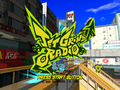
Jet Set Radio (ジェット セット ラジオ), called Jet Grind Radio in North America, is a video game developed by Sega Software R&D Dept. 6 (renamed Smilebit between the Japanese and Western releases) and published by Sega for the Sega Dreamcast. It is a third-person action game in which the player controls members of a rebellious gang called the GGs, roaming the streets of the fictional city Tokyo-To spraying graffiti to "take over" the area from rival gangs.
Jet Set Radio is considered to be one of the pioneers of its generation for its use of "cel-shaded" graphics, and its then-original style of gameplay. It is also notable for its soundtrack spearheaded by Hideki Naganuma.
Contents
Plot

The game begins in 2000, Shibuya-cho, and is introduced by Professor K, the DJ of a pirate radio station based in Tokyo-to, who explains the basics of life in Tokyo-to for a "rudie", the term he uses to refer to young people who roam the streets spraying and skating. The city is split into three parts—Shibuya-cho, Benten-cho and Kogane-cho, each of which corresponds to a different time of day. Shibuya is a shopping district full of blue skies and daylight, Benten a nocturnal entertainment spot that represents night, and Kogane a mostly residential area, built on the water, where it is perpetually sunset.
Chapter 1 - GG
In each of these areas the player will encounter a rival gang - the Love Shockers in Shibuya, the Noise Tanks in Benten, and Poison Jam in Kogane - that attempts to usurp the GG's home turf. The player starts off forming a skate gang which also resides in Shibuya-cho, and thus forms a rivalry between the gangs in the area. After completing a set of menial challenges, designed to introduce the player to the control system, Gum and Tab join the gang forming the first 3 members of the GG's. The player starts out as Beat, a 17-year-old rudie who ran away from home like many other Japanese rudies. Beat was first shunned from gang to gang over and over again until he decided to start his own gang. Beat is the leader and founder of the GG's. The player first starts out spraying a little graffiti in Shibuya-Cho looking to recruit members. First Gum joins, then Tab.
The initial stage is set in a Shibuya bus station, in which the player has to "tag" various parts of the bus station, as well as spray over existing tags, so as to gain the area as part of their territory. While tagging these places, the player is pursued by policemen and their leader, Captain Onishima. The police, the S.W.A.T team, and Goji Rokkaku's Golden Rhinos are yet another obstacle to avoid while defeating rival gangs. Also, Professor K narrates specific parts of the game via his eponymous pirate radio station called Jet Set Radio.
Other gangs which feature in the game as opponents are the Noise Tanks, who appear to be semi-cyborgs, Poison Jam, brutish thugs who wear fish costumes, and the Love Shockers, an all-girl gang made up of jilted lovers. Once the protagonist defeats each gang they hand over their belongings and grant the area to the graffiti gang that dethroned them.
Chapter 2 - Combo & Cube
Unlike the other chapters, the story beats are told through the perspective of Combo, who is a leader of a gang from Grind City. He comes to Tokyo-to to enlist the help of the GGs and tries to convince them to listen to their story and offer their help. Two months ago, Combo and his group who consists of Cube and Coin dominate the streets of Grind City. Lately, someone has been painting these symbols of Rhinos, covering up their old artwork. Coin has also gone missing, along with his record collection being completely destroyed. Black cars and men in black suits start to populate around the area. Combo and Cube try to investigate.
During their investigation, they run across a message sprayed on the wall telling them to go to Grind Square, possibly a message from Coin. They suspect these strange figures are around there as well. They start spraying graffiti all over Grind Square to bait them to come crash their operation. They learn shortly that Grind Square is actually formed and owned by the Rokkaku Group. They start to see a connection with the men in black suits with the Rokkaku group. They run across another message from Coin of a Golden Rhino. Unsure of what this symbol meant, Combo went through his sources to see who else could help in this situation. After hearing about the GGs and the pirate radio station Jet Set Radio thats been spreading through word of mouth, Combo and Cube set off for Tokyo-to.
Chapter 3 - Golden Rhinos

Towards the end of the game the GGs are hunted by the henchmen of Goji Rokakku, leader of The Golden Rhinos. Once the protagonist successfully usurps the areas seized by the Golden Rhinos, the player then must defeat Goji on a giant rooftop record player, on which Goji has assembled "The Devil's Contract", a record which, when played, is supposed to summon a demon. Goji wants to use the demon to take over Tokyo and eventually the world. After defeating him, however, it is revealed that the record is just an unusual indie release.
Gameplay
Garage
All gameplay options appear in the garage which acts as the headquarters for the GGs that provides a number of options that can be set before going out on a mission. Each area of Tokyo-to and Grind City have four game types with each one unlocking after completion of a story mode challenge. Periodically a character will randomly arrive to challenge the GG's in a Rival Challenge.
- Street - Allows you to access different missions such as...
- Story Mode - Investigate an area by spray painting all areas marked with red arrows.
- Jet Crush - Chalennge a GG member to race to a graffiti tag spot. The first to tag the spot wins.
- Jet Graffiti - Spray all areas marked with red arrows under the time limit.
- Jet Technique - Obtain the highest score under the time limit.
- Rival Challenge - A random challenge will appear. A character will either initiate a race or want you to copy their moves and tricks.
- Graffiti - Map graffiti and create graffiti with the in-game editor.
- System - Save & Game Settings
- BGM Mode - Listen to all the in-game tracks
- Internet - Depending on which version has different functions
- (Original) Links to the original Jet Set Radio website, which is no longer active.
- (Sega Heritage) Access leaderboards and view unlocked achievements.

The main mechanic revolves around spray painting. Collecting enough spray cans will allow you to tag any area marked with an arrow. There are numerous spots to tag graffiti on that are indicated by two arrows. Red Arrows are required to complete a mission, while Green Arrows are not required, but will boost your score. When near a spot that can be tagged, an icon will appear over the character's head indicating which graffiti type they will put on the spot which can done by pulling the  trigger. Depending on the tag's size and the size of the arrow indicator next to the tag spot, either small, large or extra large will determine the amount of time needed to spray the area. Small tags take no time at all, but large and extra large tags will initiate a mini game to place on spray patterns. Onscreen arrows will appear requiring the player to tilt the control stick in specific directions. Each indicator links with another and grades overall performance and costs one spraycan on completion of a pattern. By completing all the on screen indicators, this will add to a combo which provides increasingly difficult patterns that provide more points. Tilting the control stick too fast or inputting the wrong direction will automatically lose the spraycan and start from the first pattern motion. The progress of the tag remains the same otherwise.
Actions in the game add up to the total score. Besides spray painting, performing tricks and maneuvers will net additional points. Some of which require grinding. Grinding also helps navigate different areas in a stage. During a grind, holding a direction on the control stick allows to sharply turn in that direction. Successive tricks chain together, however tricks will only chain together during grinds. Unlike other sports games, such as Tony Hawk's Pro Skater which came out earlier, the game acts more like a platformer where navigation plays a key role in the game.
There are numerous ways to gain points.
- Grinding on rails periodically adds points.
- Jumping when sliding down a grind rail quickly (After a dash preferrably.)
- Jumping onto certain diagonal walls performs a wall ride.
- Jumping during a wall ride will perform a trick and help gain additional height.
- Pulling down then up quickly on the control stick will perform a quick turn.
- Pulling down then up quickly on the control stick while jumping (
 ) performs a twist, which also turns the character around.
 - Letting the skater skate in reverse. Pressing jump when near the top of a half pipe or ramp will perform a trick jump.
Once a stage is finished, remaining time and health are also calculated into the total score.
Another tactic for moving around areas quickly is holding the  Trigger behind cars which will cause skaters to skitch behind them (Holding onto them,) which is useful for clearing hilly environments.

During story missions, the police or some other law enforcement will slowly catch on to any vandalism appearing in town. Depending on how many graffiti spots are tagged determine when authorities appear and their difficulty. Drones will try to jump onto you to slow you down and eventually knock you over preventing you from escaping quickly. Other threats such as officers will appear with weapons to try to "regulate" vandalists. Boosting with the trigger makes you invulnerable to most of their attacks, but some can also be tired out from chasing you, or you can knock them over to spray their backs to stun them for a period of time. Other threats such as helicopters, assassins or jetpack patrollers will appear in successive missions and increased threat levels. The general tactic to avoid them is to flee the area or lure any potential threat away from graffiti tag spots. Some law enforcement types may disappear based on the threat level achieved providing easier access to graffiti tag spots.
Controls
Control Stick - Move character/Place Graffiti pattern
 - Jump
Trigger - Dash
Trigger - Center Camera/Spray Graffiti*
RIght Control Stick** - Rotate Camera
*Can disable center camera function in Sega Heritage version.
**Only in Sega Heritage version.
Score Rankings
At the end of all score based challenges is a ranking system that grades your performance. The more points acquired, the higher the ranking, with the highest being Jet.
- Jet
- Nitro
- Turbo
- Engine
- Motor
- Pedal
Playable Characters
The game features a host of playable characters with three varying attributes: Power, technique and graffiti. Power determines the amount of health a character has, technique determines how many points a character generates while performing tricks and the character's overall speed, and graffiti determines how many points are earned by tagging graffiti spots and how difficult the on screen indicators will be as well as how many spraycans can be carried at once. The higher the gauge, the more points you get and the more difficult a spray is, but the fewer spraycans can be carried. Even with a diverse set of characters, each character plays differently from one another, allowing to choose which one fits your play style.

|
Beat |
|---|---|
| Profile Leader of the GGs. Players start as this character. Power: ■■■■■■■□ Technique: ■■■■□□□□ Graffiti: ■■■■■■□□ | |

|
Gum |
| The first recruit of the GGs. Demonstrates basics of controls. Power: ■■■■□□□□ Technique: ■■■■■□□□ Graffiti: ■■■■■■■■ | |

|
Corn/Tab |
| The second recruit of the GGs. Challenges Beat to perform several stunts. Power: ■■■■■■□□ Technique: ■■■■■■■□ Graffiti: ■■■■□□□□ | |

|
Garam |
| Challenges the GGs to perform stunts. Power: ■■■■■■■□ Technique: ■■■■■□□□ Graffiti: ■■■■□□□□ | |

|
Yoyo |
| Challenges the GGs to a race. Power: ■■■■□□□□ Technique: ■■■■■■■□ Graffiti: ■■■■■■■■ | |

|
Mew/Bis |
| Challenges the GGs to perform stunts. Power: ■■■■□□□□ Technique: ■■■■■■■□ Graffiti: ■■■■■■□□ | |

|
Combo |
| Leader of a small group who enlists the help of the GG's after being chased out of Grind City. Power: ■■■■■■■■ Technique: ■■■■□□□□ Graffiti: ■■■■■■□□ | |

|
Cube |
| Partner of Combo's who was also chased out of Grind City. Power: ■■■■■■□□ Technique: ■■■■■□□□ Graffiti: ■■■■■■■□ | |

|
Piranha/Sugar |
| Challenges the GGs to perform stunts. Power: ■■■■■■□□ Technique: ■■■□□□□□ Graffiti: ■■■■■■■■ | |

|
Slate/Soda |
| Challenges the GGs to a race. Power: ■■■■■■■□ Technique: ■■■□□□□□ Graffiti: ■■■■■□□□ |
Secret Characters

|
Love Shockers |
|---|---|
| A member of the Love Shockers gang Power: ■■■■□□□□ Technique: ■■■■■■■■ Graffiti: ■■■■□□□□ | |

|
Noise Tank |
| A member of the Noise Tanks Power: ■■■■■■■□ Technique: ■■■■■□□□ Graffiti: ■■■■■■■■ | |

|
Poison Jam |
| A member of Poison Jam, comes in masked and unmasked. Power: ■■■■■■■■ Technique: ■■■□□□□□ Graffiti: ■■■■■■□□ | |

|
Goji |
| Leader of the Rokkaku group. Must obtain Jet rankings on all Grind City levels. Power: ■■■■■■■■ Technique: ■■■□□□□□ Graffiti: ■■■■■■■■ | |

|
Pots |
| GGs star pet. Obtain Jet rankings on all story and bonus challenges. Power: ■□□□□□□□ Technique: ■■■■■■■□ Graffiti: ■■□□□□□□ |
Items

|
Yellow Spray Can |
|---|---|
| Provides one spray can | |

|
Blue Spray Can |
| Provides five yellow spray cans | |

|
Red Spray Can |
| Provides health for the player character. The larger the can, the more health given back. | |

|
Graffiti Soul |
| Awards graffiti artwork to assign in the graffiti editor. Can award a small, large or extra large size. |
Environments
Tokyo-to
- Shibuya-Cho
- Shibuya GG
- Love Trap
- Love Attack
- Explosion
- Kogane-Cho
- The Monster of Kogane!
- No. 540
- Kogane Circus
- Fight or Flight
- Benten-Cho
- Benten Boogie
- Graffiti High
- Noise Reduction
- Benten Burning
- Behind the Mask
Grind City
- Bantam Street
- Tag or Die
- Grind Square
- Rock' N Roll Grind
Graffiti

Each environment in the game allows you to tag areas with three types of graffiti sizes. Unlocking characters and collecting Graffiti Soul icons in stages will provide additional graffiti artwork to assign. In addition graffiti can be created from the in-game graffiti error. The Dreamcast version allowed users to create and trade artwork on a Dreamcast VMU and trade locally or online. In addition Sega allowed users to convert *.jpeg images to graffiti tags by holding  while pressing . Because Sega has since shut down their online services, the website is no longer available.
When Sega re-released the game under the Sega Heritage line, Sega did not allow graffiti tags to be traded online, but still allowed users to create their own tags under a finite amount. Mobile versions of the game, as well as the PlayStation Vita version allowed to take stored images or camera snapshots for graffiti tags.
The Editor
The editor allows to create detailed artwork from within the game. Allowing for stylized font or entirely freehanded painting.
- Graffiti Size - Graffiti can be saved in three types of sizes.
- Small
- Large
- Extra Large
- Text - Enter text to appear in the image.
- Shape of Letter - Allows you to change the shape of the letter by using a wheel to indicate various types of shapes. Can change all letters or individual letters.
- Retouch Mode - Can make additional adjustments to text.
- Move Letter - Can move all or individual letters.
- Change Size - Change the size of the letters with the analog control stick or use
 or
or  to change their depth.
 - Rotate Letter - Can change all or individual letter orientation using the analog stick to turn along y axis or use and to change x axis orientation.
- Change Lens - Change from between four different lens effects.
- Change Texture - Select from 125 different textures to overlay text.
- Freehand Painting - Paint additional colors and designs using the triggers.
- Paint Layer - Choose from 130 different colors with the D-Pad, move paint cursor with the analog stick and use trigger to paint a thin line and to paint a thick line. Depending on how far the analog trigger is pressed determines how thick the line will be for either line type.*
- Paint Layer - Choose from 130 different colors with the D-Pad, move paint cursor with the analog stick and use
* In the Sega Heritage version, the triggers do not respond to analog pressure at all.
- Erase - Use erase tool to erase from specified layer.
- Erase All - Erase selected layer.
- Enlarge Painting - Used to zoom in on painting to provide better detail.
- 1X
- 2X
- 4X
- Switch Layer - Allows to paint above or below text.
History
Development
Much like Panzer Dragoon before it, when the game development division was going under turnover, Jet Set Radio came out of a desire of young developers who only had minor roles in games before to create something completly new on their own. Director, Masayoshi Kikuchi, art director Ryuta Ueda and composer Hideki Naganuma consider themself to be the core of the game and it's idendity. The game's programmers had it's roots in SEGA PC, and when switching to Dreamcast development, it was very easy for them to create striking and strong visuals.
Jet Set Radio was first announced at the 1999 Tokyo Game Show and generated a prodigious amount of press attention due to its use of the then revolutionary rendering technique, "cel-shading". Now commonplace in game design, cel-shading allows for a "cartoon-like" appearance for objects rendered in 3D.
Legacy
Jet Set Radio was not a commercial success, however its use of cel-shaded graphics have inspired many more games in the years which have followed. It was succeeded by Jet Set Radio Future in 2002 - an early release for the Xbox, though also saw a pseudo-sequel in the form of Ollie King, released for Sega Chihiro arcade hardware in 2004. The 2001 release of Wild Riders was also likely inspired by Jet Set Radio's graphical style. Cameos of Jet Set Radio, are to be found in Yakuza, Sega Superstars Tennis, Sonic & Sega All-Stars Racing, Sonic & All-Stars Racing: Transformed, 7th Dragon III Code: VFD and Sonic Forces. Hideki Naganuma's style of music employed in this game is also thought to have influenced his subsequent works at Sega and onwards.
Sequels and re-releases
The game was also brought to the Game Boy Advance (also called Jet Set Radio) and a sequel was released for the Xbox in the form of Jet Set Radio Future. Jet Set Radio was also re-released for digital services under the Sega Heritage label on Xbox Live Arcade, PlayStation Network for PlayStation 3 and PlayStation Vita, Steam, iOS and Android. The iOS and Android versions were removed from sale in 2014.[19]
Versions
There are four slightly different releases of Jet Set Radio: Japanese, US, PAL, and De La Jet Set Radio. The original game was considered unappealing by Sega of America and Sega Europe, who both made steps to try and localise the overly-Japanese atmosphere into something that had a better chance of selling in their target markets.
The original release of Jet Set Radio first went on sale in Japan on the 29th of June, 2000. This is a bog-standard version of the game which was superseded by later versions. Like many Dreamcast games in the region, sales were disappointing, with less than 40,000 copies sold in its first week of sale[20].
When brought to North America, the game ran into unforeseen trademark issues, causing it to be renamed "Jet Grind Radio". This was an almost last-minute change, meaning only the title screen and credits were changed - the term "Jet Set Radio" is still heard numerous times in-game. English voice actors were brought in to re-dub the characters and two entirely new levels were created. Some music was also changed, bringing in American hip hop bands to replace Japanese tunes. Online support through SegaNet was also included, allowing users to download tags.
Sega held a "Graffiti is art" exposition in San Francisco to promote the game.[21]
PAL regions received Jet Set Radio shortly afterwards, with all the additions of the North American version, bar the changed name. Once again some of the music was replaced.
De La Jet Set Radio
Not wanting to be left behind, Japan would recieve an updated version of the game titled De La Jet Set Radio. De La contains the additions of the overseas versions, however also tweaks gameplay, fixes several bugs in the process. De La Jet Set Radio is considered to be easier to pick up and play as a result. Its music is adopted from the North American release. De La was originally only available via Sega Direct, however a full retail version showed up in the months which followed.
Though sales were strong enough in Japan to lead to a Dorikore re-release, Jet Set Radio largely failed to capture the market in the west.
Production credits
- Main article: Jet Set Radio/Production credits.
Soundtrack
There are thirty overall tracks that have been made for Jet Set Radio across all regions and versions of the game. The entire soundtrack (Save for one) was brought together in the Sega Heritage release of the game. Most of the main levels have either a random cycle of select songs, or in challenge missions only one song that will play in the background during gameplay. The soundtrack was released on CD in Japan in 2000 by Universal Music Japan and the US version was released in 2012 by Sumthin Else Records.
| Name | Artist | Note |
|---|---|---|
| "Let Mom Sleep" | Hideki Naganuma | |
| "Humming the Baseline" | Hideki Naganuma | |
| "Moody's Shuffle" | Hideki Naganuma | |
| "Rock It On" | Hideki Naganuma | |
| "Sneakman" | Hideki Naganuma | |
| "Sweet Soul Brother" | Hideki Naganuma | |
| "That's Enough" | Hideki Naganuma | |
| "Grace and Glory" | Hideki Naganuma | |
| "Funky Radio" | B.B. Rights | |
| "Mischievous Boy" | Castle Logical | |
| "Dunny Boy Williamson Show" | Deavid Soul | Japanese Version Only |
| "Miller Ball Breakers" | Deavid Soul | |
| "On the Bowl (A. Fargus Remix)" | Deavid Soul | |
| "Up-Set Attack" | Deavid Soul | |
| "Yappie Feet" | Deavid Soul | Not available in the Sega Heritage Release |
| "Yellow Bream" | F-Fields | |
| "Magical Girl" | Guitar Vader | |
| "Super Brothers" | Guitar Vader | |
| "OK House" | Idol Taxi | |
| "Bout the City" | Reps | |
| "Everybody Jump Around | Richard Jacques | |
| "Electric Tooth Brush" | Toronto | |
| "Just Got Wicked" | Cold | US Version Only |
| "Recipe for the Perfect Afro" | Feature Cast | PAL Version Only |
| "Improvise" | Jurassic 5 | US and PAL Versions Only |
| "Patrol Knob" | Mix Master Mike | US and PAL Versions Only |
| "Many Styles" | O.B. One | PAL Version Only |
| "Slow" | Professor Murder Music | US Version Only |
| "Dragula" | Rob Zombie | US Version Only |
| "Funky Plucker" | Semi Detached | PAL Version Only |
Magazine articles
- Main article: Jet Set Radio/Magazine articles.
Promotional material


also published in:
- Bonus (YU) #8: "8/2000" (2000-10-25)[22]
- Bonus (YU) #9: "9/2000" (2000-12-25)[23]
- Bonus (YU) #10: "1/2001" (2001-02-25)[24]
- Bonus (YU) #11: "2/2001" (2001-03-25)[25]
- Bonus (YU) #12: "3/2001" (2001-04-25)[26]
- Bonus (YU) #13: "4/2001" (2001-05-25)[27]
- Bonus (YU) #14: "5/2001" (2001-06-25)[28]
- Bonus (YU) #15: "6/2001" (2001-07-25)[29]
also published in:
- Electronic Gaming Monthly (US) #137: "December 2000" (2000-10-30)[30]
Artwork


Physical scans
|
88 |
|---|---|
| Based on 46 reviews | |
| Dreamcast, JP |
|---|
  Cover
|
 Spinecard  Disc  Manual  Inlay |
| Dreamcast, US |
|---|
  Cover
|
 Disc  Manual  Inlay |
| Dreamcast, EU |
|---|
  Cover
|
 Disc |
| Dreamcast, EU (White) |
|---|
|
 Disc |
| Dreamcast, PT |
|---|
  Cover
|
Disc |
| Dreamcast, AU |
|---|
 Cover
|
Disc |
| Dreamcast, BR |
|---|
  Cover
|
 Disc  Manual  Inlay |
Technical information
Jet Set Radio runs at up to 57,378 polygons per scene.[78]
Save data
The Dreamcast version supports one save file for gameplay progression, one for system settings, and three types of graffiti images created within the graffiti editor in small, large and extra large sizes. The game will also save a VMU application dedicated to managing graffiti files if there is enough space available.
| Name | File Name | Comment | File Size | Icon |
|---|---|---|---|---|
| JETSETRADIO SYSTEM | JETSET_SYSTEM | JET_SYSTEM | 4 blocks | 
|
| JETSETRADIO VM APPLICATION DATA | JETSET_VM | JETSET_VM | 30 blocks | 
|
| JETSETRADIO SMALL | JET_GRAFFITI_S | JETSET_SMA | 8 blocks | 
|
| JETSETRADIO LARGE | JET_GRAFFITI_L | JETSET_LAR | 13 blocks | 
|
| JETSETRADIO XLARGE | JET_GRAFFITI_XL | JETSET_XLA | 22 blocks | 
|
| Name | File Name | Comment | File Size | Icon |
|---|---|---|---|---|
| JETGRINDRADIO SYSTEM | JETGRIND_SYSTEM | JET_SYSTEM | 4 blocks |
|
| JETGRINDRADIO VM APPLICATION DATA | JETGRIND_VM | JETGRIND_VM | 30 blocks |
|
| JETGRINDRADIO SMALL | JET_GRAFFITI_S | JETGRIND_SMA | 8 blocks |
|
| JETGRINDRADIO LARGE | JET_GRAFFITI_L | JETGRIND_LAR | 13 blocks |
|
| JETGRINDRADIO XLARGE | JET_GRAFFITI_XL | JETGRIND_XLA | 22 blocks |
|
Technical information
- Main article: Jet Set Radio/Technical information.
ROM dump status
| System | Hash | Size | Build Date | Source | Comments | |||||||||
|---|---|---|---|---|---|---|---|---|---|---|---|---|---|---|
|
|
GD-ROM (JP) | ||||||||||||
|
|
GD-ROM (US) | ||||||||||||
|
|
GD-ROM (EU) | ||||||||||||
|
|
2000-08-22 | GD-R | Page | ||||||||||
|
|
2000-10-03 | GD-R | Page |
External links
- Sega of America webpage: Dreamcast
- Sega of Japan catalogue pages (Japanese): Dreamcast
- Sega.com Asia webpage: Dreamcast
- Sega.com Asia webpage (Chinese): Dreamcast
References
- ↑ File:Jsr dc jp back cover.jpg
- ↑ 2.0 2.1 2.2 http://sega.jp/dc/000607/ (Wayback Machine: 2007-10-17 02:16)
- ↑ https://sega.jp/history/hard/dreamcast/software.html (Wayback Machine: 2020-10-23 17:28)
- ↑ http://sega.com:80/games/dreamcast/post_dreamcastgame.jhtml?PRODID=177 (Wayback Machine: 2003-12-13 17:26)
- ↑ http://www.ebworld.com/ebx/categories/newReleases/morenr-DC.asp (Wayback Machine: 2000-11-09 20:26)
- ↑ Press release: 2000-10-31: Jet Grind Radio Brings Graffiti Art, Street Beats and Futuristic In-Line Skating to Sega Dreamcast
- ↑ http://www.chipsworld.co.uk/detProd.asp?ProductCode=3120 (Wayback Machine: 2000-12-06 02:08)
- ↑ http://amazon.co.uk/exec/obidos/tg/stores/static/-/videogames/bs-dreamcast (Wayback Machine: 2001-02-20 22:04)
- ↑ 9.0 9.1 DC-UK, "December 2000" (UK; 2000-10-23), page 52
- ↑ 10.0 10.1 Sega Magazin, "Dezember 2000" (DE; 2000-1x-xx), page 15
- ↑ 11.0 11.1 Computer & Video Games, "December 2000" (UK; 2000-11-15), page 100
- ↑ 12.0 12.1 Dreamcast Magazine, "No. 15" (UK; 2000-11-02), page 48
- ↑ http://www.amazon.de/exec/obidos/ASIN/B00004XQWB (Wayback Machine: 2005-05-06 01:35)
- ↑ http://www.micromania.fr/zooms/?ref=17730 (Wayback Machine: 2000-12-15 02:08)
- ↑ http://www.amazon.fr:80/exec/obidos/tg/browse/-/557790/ref=vg_br_dp_2_lf/t/ (Wayback Machine: 2001-07-14 21:30)
- ↑ http://www.centromail.es:80/top/ficha.asp?codmail=15765 (Wayback Machine: 2001-07-18 04:17)
- ↑ http://www.gameswarehouse.com.au/longpage.asp?gameid=4547 (Wayback Machine: 2002-01-07 13:41)
- ↑ 18.0 18.1 Hyper, "January 2001" (AU; 2000-11-22), page 84
- ↑ http://segabits.com/blog/2014/10/24/sega-pulls-jet-set-radio-from-the-app-store-and-soon-from-google-play/
- ↑ Electronic Gaming Monthly, "September 2000" (US; 2000-08-08), page 37
- ↑ Next Generation, "January 2001" (US; 2000-12-21), page 16
- ↑ Bonus, "8/2000" (YU; 2000-10-25), page 82
- ↑ Bonus, "9/2000" (YU; 2000-12-25), page 82
- ↑ Bonus, "1/2001" (YU; 2001-02-25), page 82
- ↑ Bonus, "2/2001" (YU; 2001-03-25), page 82
- ↑ Bonus, "3/2001" (YU; 2001-04-25), page 82
- ↑ Bonus, "4/2001" (YU; 2001-05-25), page 48
- ↑ Bonus, "5/2001" (YU; 2001-06-25), page 2
- ↑ Bonus, "6/2001" (YU; 2001-07-25), page 46
- ↑ Electronic Gaming Monthly, "December 2000" (US; 2000-10-30), page 82
- ↑ Neo Plus, "Kwiecień 2001" (PL; 2001-xx-xx), page 100
- ↑ Neo Plus, "Maj 2001" (PL; 2001-xx-xx), page 100
- ↑ Neo Plus, "Czerwiec 2001" (PL; 2001-xx-xx), page 100
- ↑ Neo Plus, "Lipiec-Sierpień 2001" (PL; 2001-xx-xx), page 84
- ↑ Neo Plus, "Wrzesień 2001" (PL; 2001-xx-xx), page 84
- ↑ 576 Konzol, "Szeptember 2000" (HU; 2000-xx-xx), page 42
- ↑ Ação Games, "Setembro 2000" (BR; 2000-xx-xx), page 64
- ↑ Alaab Alcomputtar, "" (SA; 2001-03-xx), page 18
- ↑ Bonus, "6/2000" (YU; 2000-08-25), page 51
- ↑ Click!, "2/2001" (PL; 2001-01-18), page 28
- ↑ Consoles +, "Août 2000" (FR; 2000-07-xx), page 80
- ↑ Consoles +, "Décembre 2000" (FR; 2000-1x-xx), page 98
- ↑ Dreamcast Monthly, "Christmas 2000" (UK; 2000-11-23), page 90
- ↑ Dreamcast Magazine, "2000-22 extra (2000-07-07ex)" (JP; 2000-06-23), page 38
- ↑ Dreamcast Magazine, "No. 12" (UK; 2000-08-10), page 72
- ↑ Dorimaga, "2002-18 (2002-10-11)" (JP; 2002-09-27), page 33
- ↑ Edge, "September 2000" (UK; 2000-08-14), page 92
- ↑ Electronic Gaming Monthly, "January 2001" (US; 2000-12-05), page 193
- ↑ Entsiklopediya igr dlya Dreamcast, "Izdaniye chetvertoye, dopolnennoye" (RU; 2002-xx-xx), page 104
- ↑ Famitsu, "2000-07-07" (JP; 2000-06-23), page 31
- ↑ Fun Generation, "08/2000" (DE; 2000-07-19), page 72
- ↑ Fun Generation, "12/2000" (DE; 2000-11-22), page 55
- ↑ GameFan, "Volume 8, Issue 9: September 2000" (US; 2000-xx-xx), page 22
- ↑ GameFan, "Volume 8, Issue 12: December 2000" (US; 2000-1x-xx), page 24
- ↑ GamePlay RPG, "Décembre 2000" (FR; 2000-1x-xx), page 108
- ↑ GamePro, "January 2001" (US; 200x-xx-xx), page 101
- ↑ Gamers' Republic, "December 2000" (US; 2000-xx-xx), page 74
- ↑ Joypad, "Septembre 2000" (FR; 2000-xx-xx), page 96
- ↑ MAN!AC, "09/2000" (DE; 2000-08-02), page 42
- ↑ MAN!AC, "12/2000" (DE; 2000-11-02), page 68
- ↑ Mega Fun, "09/2000" (DE; 2000-08-02), page 58
- ↑ Mega Fun, "12/2000" (DE; 2000-11-02), page 48
- ↑ Neo Plus, "Styczeń 2001" (PL; 2001-xx-xx), page 61
- ↑ Next Generation, "September 2000" (US; 2000-08-15), page 101
- ↑ Next Generation, "January 2001" (US; 2000-12-21), page 99
- ↑ Official Dreamcast Magazine, "December 2000" (UK; 2000-11-02), page 70
- ↑ Official Dreamcast Magazine, "December 2000" (US; 2000-10-31), page 92
- ↑ Playmag, "Septembre 2000" (FR; 2000-xx-xx), page 36
- ↑ Play, "Kwiecień 2001" (PL; 2001-xx-xx), page 26
- ↑ PSX Extreme, "03/2001" (PL; 2001-0x-xx), page 39
- ↑ Power Unlimited, "Jaargang 9, Nummer 1, Januari 2001" (NL; 200x-xx-xx), page 34
- ↑ Sega Magazin, "September 2000" (DE; 2000-07-31), page 16
- ↑ Sega Magazin, "Dezember 2000" (DE; 2000-1x-xx), page 14
- ↑ Strana Igr, "Avgust 2000 1/2" (RU; 2000-xx-xx), page 54
- ↑ Strana Igr, "Sentyabr 2000 2/2" (RU; 2000-xx-xx), page 19
- ↑ Video Games, "09/2000" (DE; 2000-08-02), page 96
- ↑ Video Games, "12/2000" (DE; 2000-11-02), page 86
- ↑ jetsetdc
| Jet Set Radio | |
|---|---|
|
Main page | Comparisons | Achievements | Changelog | Credits | Hidden content | Development | Magazine articles | Video coverage | Reception | Merchandise | Bootlegs
Music: Jet Grind Radio Music Sampler (2000) | Jet Set Radio Original Sound Tracks (2000) | Jet Set Radio Sega Original Tracks (2012) | |

| Jet Set Radio series of games | |
|---|---|
|
Jet Set Radio (2000) | De La Jet Set Radio (2001) |
 |
Typing Jet (2001) |
 |
Jet Set Radio Future (2002) | Sega GT 2002/Jet Set Radio Future (2002) |
 |
Jet Set Radio (2003) |
 |
Jet Set Radio (2005) |
    |
Jet Set Radio (2012) |
  |
Jet Set Radio (2012) |
| Jet Set Radio related media | |
 |
Jet Grind Radio Music Sampler (2000) | Jet Set Radio Original Sound Tracks (2000) | Jet Set Radio Future Music Sampler (2002) | Jet Set Radio Future Original Sound Tracks (2002) | Jet Set Radio Original Soundtrack (2012) | Jet Set Radio Sega Original Tracks (2012) | Jet Set Radio Future Sega Original Tracks (2012) |
 |
Jet Set Radio Perfect Guide (2000) | Jet Grind Radio: Sybex Official Strategies & Secrets (2000) | Jet Set Radio Future Perfect Guide Book (2002) |
| Other | List of Jet Set Radio merchandise |
- Jump Pack-compatible games
- Dreamcast Modem-compatible games
- Dreamcast VGA Box-compatible games
- Visual Memory Unit-compatible games
- 1 player games
- JP Dreamcast games
- US Dreamcast games
- EU Dreamcast games
- DE Dreamcast games
- ES Dreamcast games
- FR Dreamcast games
- PT Dreamcast games
- UK Dreamcast games
- AU Dreamcast games
- BR Dreamcast games
- Dreamcast games
- 2000 Dreamcast games
- All 2000 games
- Dreamcast action games
- Dreamcast games with ADX audio
- Dreamcast games using Flash
- All games
- Old-style rating (cinescape)
- Old-style rating (gamesmaster)
- Rating without source
- Update ratings template
- 2 old ratings
- Missing ROM hashes
- Games with known prototypes
- Old technical information
- Jet Set Radio
- Jet Set Radio (franchise)