Nazo Puyo Arle no Roux
From Sega Retro
| Nazo Puyo Arle no Roux | |||||||||||||||
|---|---|---|---|---|---|---|---|---|---|---|---|---|---|---|---|
| System(s): Sega Game Gear, Virtual Console | |||||||||||||||
| Publisher: Sega | |||||||||||||||
Developer:   | |||||||||||||||
| Genre: Puzzle[2][3] | |||||||||||||||
| Number of players: 1 | |||||||||||||||
|


This short article is in need of work. You can help Sega Retro by adding to it.
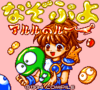
Nazo Puyo Arle no Roux (なぞぷよ アルルのルー) is a puzzle game developed by Compile for the Sega Game Gear and released exclusively in Japan in 1994. Despite being the third game in the Nazo Puyo subseries, it is drastically different from the previous games, taking a combined RPG/puzzle approach to its (now existent) storyline. This game would itself receive two sequels, both on the Super Nintendo Entertainment System: Super Nazo Puyo: Rulue no Roux, combining a retooled version of this game with a new story mode focusing on Rulue, and Super Nazo Puyo Tsu: Rulue no Tetsuwan Hanjouki, a new game focusing exclusively on Rulue.
Contents
Gameplay
There are two game modes: Nazo Puyo, which is the main game, and Toko Puyo, which is merely an endless mode as in Puyo Puyo.
Nazo Puyo
The story is simple: Arle Nadja wants to make rice for dinner and decides to go to town to get the ingredients; the townsfolk will only give her the ingredients if she completes Nazo Puyo challenges.
Arle travels around the town, talking to people on the street who put her in Nazo Puyo matches. Simply use the D-pad to move and  to talk.
In a Nazo Puyo match, you must complete the mission with no more than the beans provided — the top of the screen either shows you a list of available puyo or one puyo that will be repeated a given number of times. START allows you either to retry the mission or give up. Otherwise, controls are the same as in Puyo Puyo.
The RPG part comes in that Madou Monogatari's health system is applied to the missions. Arle's health isn't shown numerically, but rather must be guessed through Arle's facial expression on the right side of the screen. Failing a mission lowers Arle's health. The game ends when Arle "dies." Each completed mission will add a bunch of jewels to spaces on the screen; filling all the spaces will level you up, restoring health. Health is also restored after completing all of one person's missions.
Toko Puyo
Toko Puyo is the Endless mode of Puyo Puyo, with two main differences:
- Nuisance will fall at random in random amounts; likely depending on your performance.
- As in the Madou Monogatari RPGs, jewels will appear in spaces around the screen depending on how many rensa you get; filling all the spaces with jewels will level you up, making the puyo fall faster.
History
Legacy
The game was later re-released as one of the four games pre-installed on the yellow model Game Gear Micro.
Magazine articles
- Main article: Nazo Puyo Arle no Roux/Magazine articles.
Physical scans
| Sega Retro Average | |||||||||||||||||||
|---|---|---|---|---|---|---|---|---|---|---|---|---|---|---|---|---|---|---|---|
|
|
69 |
|---|---|
| Based on 3 reviews | |
| Game Gear, JP |
|---|
  Cover
|
 Cart  Manual  Reg Card |
Technical information
ROM dump status
| System | Hash | Size | Build Date | Source | Comments | |||||||||
|---|---|---|---|---|---|---|---|---|---|---|---|---|---|---|
|
|
256kB | Cartridge (JP) | |||||||||||
|
|
256kB | EPROM cartridge | Page |
External links
References
- ↑ https://www.mtwo.co.jp/development/retrogame-2/#tab-4
- ↑ File:NazoPuyoAnR GG JP Box Front.jpg
- ↑ 3.0 3.1 https://sega.jp/history/hard/gamegear/software.html (Wayback Machine: 2018-12-07 04:57)
- ↑ 4.0 4.1 http://vc.sega.jp/3ds/nazopuyo3/ (Wayback Machine: 2013-12-31 07:40)
- ↑ Beep! MegaDrive, "August 1994" (JP; 1994-07-08), page 23
- ↑ Famitsu, "1994-08-05" (JP; 1994-07-22), page 41
- ↑ Sega Saturn Magazine, "September 1995" (JP; 1995-08-08), page 88
| Nazo Puyo Arle no Roux | |
|---|---|
|
Main page | Comparisons | Maps | Hidden content | Magazine articles | Reception | |



- 1 player games
- JP Game Gear games
- Game Gear games
- 1994 Game Gear games
- All 1994 games
- Game Gear puzzle games
- JP Nintendo 3DS Virtual Console games
- Nintendo 3DS games
- All 2013 games
- 2013 Nintendo 3DS games
- Nintendo 3DS Virtual Console games
- All games
- Stubs
- Games with known prototypes
- Old technical information
- Nazo Puyo Arle no Roux
- Puyo Puyo (franchise)
- Game Gear Micro games