OutRun
From Sega Retro
| OutRun | |||||
|---|---|---|---|---|---|
| System(s): Sega OutRun Hardware, Amiga, Amstrad CPC, Atari ST, Commodore 64, DOS, J2ME, MSX, Sega Game Gear, Sega Master System, Sega Mega Drive, Sega Saturn, TurboGrafx-16, ZX Spectrum | |||||
| Publisher: Sega | |||||
Developer: Sega AM2,        | |||||
| Genre: Racing | |||||
| |||||


OutRun (アウトラン) is a successful arcade driving game developed by Sega AM2 in 1986 on specially designed hardware. It was designed by Yu Suzuki, and went on to inspire numerous sequels and re-releases. Rather than be classed as a "racing game", Yu Suzuki classifies OutRun as a "driving game".
It is one of Sega's most iconic franchises as it was the first arcade game to deliver a sense of speed while making use of Super Scaler technology to create a pseudo-3D look and feel. It also contains multiple routes and multiple endings. Its music, composed by Hiroshi Miyauchi, was also extremely popular as well, as each of the three in-game music tracks were much longer and more varied than what other arcade games were offering at the time. It was also one of the first games to allow picking a music track to race with.
The player's car looks strikingly similar to a Ferrari Testarossa, so much so that the two companies would later have some court encounters over it. In later games, the car is either generic with no obvious ties to a company, or, in the most recent games, a real Ferrari. Other cars on the road appear to be a 1972 Volkswagen Beetle, a 1971 Chevrolet Corvette, a 1985 Porsche 911, a 1985 BMW 325i Cabriolet E30 and a truck. The game's scenery is largely inspired by Europe, after a European trip Suzuki travelled on for inspiration. This would be explored in more detail in the sequel OutRun Europa.
OutRun came in four distinct styles of arcade cabinet, two upright and two sit-down. Each comes with a steering wheel and stick shift plus acceleration and brake pedals. Though steering wheels had appeared in countless Arcade games previous to Sega's game, OutRun was the first to have force feedback in order to simulate the road surface. The deluxe sit-down cabinet is also equipped with hydraulics which move the seat as the player turns.
Gameplay

The goal of OutRun is to simply drive your sports car to one of the five goals, labeled a to e, without running out of time. Crashing into either other cars or scenery does not cause the player to lose lives, just time. After an area is cleared, checkpoints will allow the player to increase their time, and there will also be the option to select the next area through the form of a fork in the road. There are five possible endings, each with their own closing cinematic.
The car has two gears, high and low. When in the high gear, the car becomes harder to control, however the top speed of the vehicle is increased. To be successful in OutRun the player needs to switch between gears at the appropriate moments, e.g. switching to the lower gear while negotiating tricky roads, or if the player has just crashed.
The number of lanes of traffic also differs between stages. Although there is never a situation in OutRun where the cars travel in the opposite direction to yourself, the introductary level for example has six lanes of traffic.
Regional Differences
The names of the stages differ between the Japanese and overseas releases of the games:
Japanese Layout
| Stage Number | Goal name | ||||
|---|---|---|---|---|---|
| 1 | 2 | 3 | 4 | 5 | |
| Vineyard | A | ||||
| Wilderness | |||||
| Desert | Death Valley | B | |||
| Wheat Field | Old Capital | ||||
| Coconut Beach | Alps | Desolation Hill | C | ||
| Cloudy Mountain | Gateway | ||||
| Devil's Canyon | Autobahn | D | |||
| Seaside Town | |||||
| Lakeside | E | ||||
Overseas Layout
| Stage Number | Goal name | ||||
|---|---|---|---|---|---|
| 1 | 2 | 3 | 4 | 5 | |
| Vineyard | A | ||||
| Wilderness | |||||
| Desert | Death Valley | B | |||
| Gateway | Old Capital | ||||
| Coconut Beach | Alps | Desolation Hill | C | ||
| Devil's Canyon | Wheat Field | ||||
| Cloudy Mountain | Autobahn | D | |||
| Seaside Town | |||||
| Lakeside | E | ||||
Coconut beach was later used as a stage in Sega Superstars Tennis.
Sequels and Re-releases

OutRun was a big success in Arcades, so it was inevitable that ports would be made to home platforms. At the time, these systems were seen to be vastly inferior to the hardware powering OutRun, and numerous cuts were made.
Various companies were contracted by U.S. Gold to produce Amiga, Amstrad CPC, Atari ST, Commodore 64, DOS, MSX and ZX Spectrum ports, which were then distributed in North America and parts of Europe. Pony Canyon handled an MSX2 conversion which only saw release in Japan. There is also TurboGrafx-16 port, handled by NEC Interchannel.
Sega were also quick to port the game to their own systems. Sega Master System and Sega Game Gear ports were handled in-house by Sega, as was a Sega Mega Drive version, seen for a while to be the best home port of OutRun.
A Sega Saturn version of the game was only released as a stand alone title in Japan as part of their Sega Ages series. It was later bundled with Space Harrier and After Burner II to make the western title Sega Ages: Volume 1. Since then, the majority of home ports of the game have been almost identical to their original arcade counterpart, with the exception of mobile phone versions and the version included in the 2004 Sega Arcade Gallery Game Boy Advance compilation (whose resolution was changed to fit the console's smaller screen).
OutRun was also released as part of the Sega Ages 2500 PlayStation 2 series in Japan, and is fully playable within Shenmue and Shenmue II. It is also unlockable within the Xbox port of OutRun 2 SP.
The game saw many sequels, however the "true" sequel comes in the form of Turbo OutRun, a 1989 arcade release also by Sega AM2. By obtaining a kit from Sega, arcade owners were able to "upgrade" OutRun into Turbo OutRun, as the two games run on identical hardware. Turbo OutRun offers several new graphical features and a turbo button.
Gallery
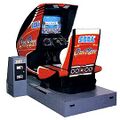
Standard cabinet
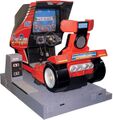
Deluxe cabinet
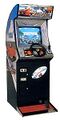
Upright cabinet


Physical Scans
| Sega Retro Average | ||||
|---|---|---|---|---|
|
| {{|L}} | N/A |
|---|---|
| Based on 0 reviews | |
Arcade Version
Template:ScanflyerTemplate:ScanflyerTemplate:ScanflyerTemplate:ScanflyerTemplate:Scanflyer
Mega Drive Version
| Mega Drive, US |
|---|
 Cover
|
 Cart |
| Mega Drive, EU |
|---|
 Cover
|
| Mega Drive, JP |
|---|
 Cover
|
 Cart |
Master System Version
| Master System, US |
|---|
 Cover
|
| Master System, US Rerelease |
|---|
 Cover
|
 Cart |
| Master System, EU |
|---|
 Cover
|
| Master System, EU "no limits" variant |
|---|
 Cover
|
| Master System, EU ® variant |
|---|
 Cover
|
| Master System, JP |
|---|
   Cover
|
 Cart |
| Master System, BR |
|---|
 Cover
|
| Master System, BR (newer) |
|---|
 Cover
|
Game Gear Version
| Game Gear, EU |
|---|
 Cover
|
| Game Gear, JP |
|---|
   Cover
|
| Game Gear, JP (Meisaku Collection) |
|---|
 Cover
|
Amiga Version
| Amiga, EU (Erbe Re-release) |
|---|
 Cover
|
| Amiga, EU (Klassix Re-release) |
|---|
 Cover
|
Amstrad CPC Version
| Amstrad CPC, EU |
|---|
|
 Disk |
Atari ST Version
| Atari ST, EU |
|---|
  Cover
|
 Disk |
Commodore 64 Version
| Commodore 64, US |
|---|
  Cover
|


MSX Version
Due to the video game industry handing out licensing rights for different media types rather than entire systems at the time, OutRun received two ports to the MSX — a cassette tape port by Probe and a cartridge port by Pony Canyon.
| MSX, JP (Cartridge) |
|---|
  Cover
|
TurboGrafx-16 Version
| TurboGrafx-16, JP |
|---|
| <div style="margin:auto; max-width:Expression error: Unexpected < operator.px">
320x80px Cover
|
ZX Spectrum Version
| ZX Spectrum, EU (Cassette) |
|---|
 Cover
|
| ZX Spectrum, EU (Disk) |
|---|
|
 Disk |


- No players field
- Old content rating field
- Use romtable template
- All games
- Old-style rating (ace)
- Rating without source
- Old-style rating (consolesplus)
- Old-style rating (cvg)
- Old-style rating (gamesmachine)
- Old-style rating (gamesmachineuk)
- Old-style rating (hobbyconsolas)
- Old-style rating (mm)
- Old-style rating (playerone)
- Old-style rating (pp)
- Old-style rating (sfuk)
- Old-style rating (tilt)
- Old-style rating (average)
- No ratings
- Pages with broken file links
- OutRun (franchise)
- OutRun Hardware Games
- 1987 Master System Games
- Master System Games
- Master System Racing Games
- 1991 Mega Drive Games
- Mega Drive Games
- Mega Drive Racing Games
- 1991 Game Gear Games
- Game Gear Games
- Game Gear Racing Games
- 1996 Saturn Games
- Saturn Games
- Saturn Racing Games
- Sega Channel Games
- Amiga Games
- Amstrad CPC Games
- Atari ST Games
- Commodore 64 Games
- DOS Games
- J2ME Games
- MSX Games
- TurboGrafx-16 Games
- ZX Spectrum Games
- Mega-Tech Games