Sega Mega Drive
From Sega Retro

| |||||||||||||||||||||||||||||||||||||||||||||||||||||||||||||||||||||||||||||||||||||||||||||||||||||||||||||||||||||||||||||||||||||||

| |||||||||||||||||||||||||||||||||||||||||||||||||||||||||||||||||||||||||||||||||||||||||||||||||||||||||||||||||||||||||||||||||||||||
| Sega Mega Drive | |||||||||||||||||||||||||||||||||||||||||||||||||||||||||||||||||||||||||||||||||||||||||||||||||||||||||||||||||||||||||||||||||||||||
|---|---|---|---|---|---|---|---|---|---|---|---|---|---|---|---|---|---|---|---|---|---|---|---|---|---|---|---|---|---|---|---|---|---|---|---|---|---|---|---|---|---|---|---|---|---|---|---|---|---|---|---|---|---|---|---|---|---|---|---|---|---|---|---|---|---|---|---|---|---|---|---|---|---|---|---|---|---|---|---|---|---|---|---|---|---|---|---|---|---|---|---|---|---|---|---|---|---|---|---|---|---|---|---|---|---|---|---|---|---|---|---|---|---|---|---|---|---|---|---|---|---|---|---|---|---|---|---|---|---|---|---|---|---|---|---|
| Manufacturer: Sega | |||||||||||||||||||||||||||||||||||||||||||||||||||||||||||||||||||||||||||||||||||||||||||||||||||||||||||||||||||||||||||||||||||||||
| Variants: Mega Drive 2, Genesis 3, Mega Jet, Nomad, Mega Tech, Mega Play, Amstrad Mega PC | |||||||||||||||||||||||||||||||||||||||||||||||||||||||||||||||||||||||||||||||||||||||||||||||||||||||||||||||||||||||||||||||||||||||
| Add-ons: Mega-CD, Sega 32X, Mega Modem, Power Base Converter | |||||||||||||||||||||||||||||||||||||||||||||||||||||||||||||||||||||||||||||||||||||||||||||||||||||||||||||||||||||||||||||||||||||||
|

The Mega Drive (メガドライブ), called the Sega Genesis in North America and Super Gam*Boy (수퍼겜보이), later Super Aladdin Boy (수퍼알라딘 보이) in South Korea, is a cartridge-based video game console developed by Sega in 1988.
Codenamed the Sega Mark V during development[13] it is Sega's fifth video game console (following the SG-1000, SG-1000 II, Sega Mark III and Sega Master System) to be released, but only the second substantial hardware upgrade. The Mega Drive's selling point was its 16-bit main processor, which in adddition to superior graphics capabilities, allowed for a more advanced gaming experience previously limited to the arcades.
The Mega Drive is Sega's most successful video game console, with 40 million hardware units sold worldwide,[14] including more than 20 million in the United States, over 9 million in Western Europe, 3.58 million in Japan, and 3 million in Brazil.[15]. It has a software library consisting of more than one thousand games; more than previous generations of Sega hardware combined.
As well as competing with Nintendo's Famicom (NES) and later Super Famicom, Sega also found itself fighting against NEC's TurboGrafx-16 (PC Engine in Japan), SNK's Neo Geo, the Atari Jaguar, and numerous home computers, driving the term "console war" as it attempted to acheive market dominance. While the Super NES ended up surpassing the Mega Drive in worldwide hardware sales (49 million), more software was sold for Sega's console, and its 16:1 attach ratio was double that of the SNES.[16]
The Mega Drive saw two major expansions to extend its shelf life, first with Sega Mega-CD in 1991 and later the Sega 32X in 1994. The Mega Drive would be succeeded by the Sega Saturn (also released in 1994), though was still receiving officially licensed games as late as 2000.
Contents
- 1 Hardware
- 1.1 Models
- 1.1.1 Mega Drive
- 1.1.2 Mega Drive 2
- 1.1.3 Genesis 3
- 1.1.4 Portables: Mega Jet and Nomad
- 1.1.5 Arcade hardware: Mega Tech, Mega Play, and the System C
- 1.1.6 Mega-CD combos: JVC Wondermega/X'eye, Pioneer LaserActive, Sega Multi-Mega, and Aiwa Mega CD
- 1.1.7 Computer combinations: Sega Teradrive, Amstrad Mega PC, al-Alamiah units
- 1.1.8 Modern System-on-a-Chip compilations
- 1.1.9 Hardware revisions
- 1.2 Cartridges
- 1.3 Technical specifications
- 1.4 Comparison
- 1.1 Models
- 2 History
- 3 Games
- 4 Production credits
- 5 Magazine articles
- 6 Promotional material
- 7 Logos by regions
- 8 External links
- 9 References
Hardware
The Mega Drive was envisioned at the next technological step over other video game consoles available at the time. It is a "16-bit" machine, named after its use of a 16-bit CPU (in this case, the Motorola 68000), and was marketed as being superior to popular "8-bit" consoles dominating the market at the time, usually the Nintendo Entertainment System (NES) but sometimes its immediate predecessor, the Sega Master System. 16-bit CPUs had been gaining popularity since the mid-80s, were widely used in arcade machines, and were almost expected to be found in new home computers - it was therefore considered logical that the next "generation" of dedicated video game consoles should follow suit.
The Mega Drive builds on technology found in the Master System (and with adaptors, is fully backwards compatible), though as well as upping the technical specifications for more demanding gameplay, sound and graphics, makes a number of crucial changes to the design of consoles which continue to this day. Firstly it added a third face button,  , to the (now ergonomically designed) control pad. The Mega Drive outputs sound in stereo, and makes an attempt to region lock games through software. Also, when utilising the right cables, the Mega Drive is natively able to produce a clearer image than its rivals (on top of its already higher resolution 320x240 display).
All Mega Drives ultilise a top-loading design (as opposed to the cumbersome VCR-style cartridge loading of the Western NES), while having removable controllers (unlike the Famicom). It was designed from day one to allow hardware expansions, and its use of dark plastic means that the "yellowing" of older systems (from bromine-based flame retardants reacting with oxygen) is less of an issue.
Models
- Main article: Mega Drive consoles.
Mega Drive
The original Mega Drive measures 28 cm×21.2 cm×7 cm. The top of the unit is split into two components: a circular emboss with the cartridge slot and a tagline (which was omitted on later versions), and a control panel containing the power and reset buttons and the volume slider for the headphones jack. Audio output through the original model was mono through the A/V port, while the headphone jack was used for stereo sound. A third DE-9 port on the back of the unit provided additional peripheral support, though was removed from later revisions.
Asian, Japanese and South Korean models have a cartridge locking mechanism which prevents cartridges from being removed when the power is on (which is why "Eastern" cartridges, as well as the Sonic & Knuckles cartridge and various others, have a cut-out on their left sides). Later runs included the TradeMark Security System, missing in early builds causing small compatibility issues, despite the feature having been planned early on.
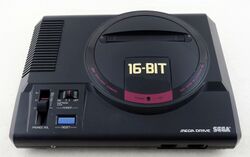
Japanese model
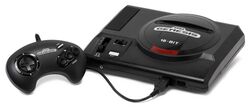
North American model
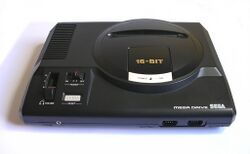
European model
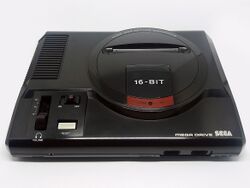
Brazilian model
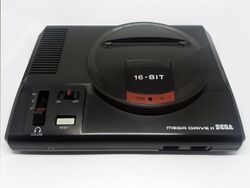
Brazilian model (Mega Drive II)
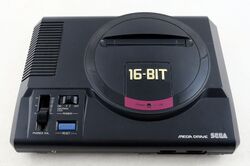
Asian model
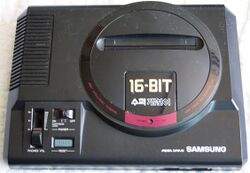
South Korean model


Mega Drive 2
1993 saw this cost-reduced redesign (known as the Mega Drive II in Europe, and sold simply as "Genesis" in North America without the Sega prefix), at 22 cm×21.2 cm×5.9 cm, being introduced internationally. One of the major revisions from the original model was the removal of the headphones jack in favor of stereo output through a redesigned 9-pin A/V port. The Mega Drive 2 also used an external RF modulator (all non-Japanese Mega Drive models had an internal modulator), which was packed in with Western systems. American and European models also used a push-button toggle switch for power while non-Western models used a slide switch like the original model. Furthermore, the audio mixing circuitry was modified, resulting in noticeably different quality audio output — here is a page with audio samples, provided by little-scale.
Contrary to popular belief, this model has a Z80, albeit in a QFP-44 form factor, which is not immediately identifiable compared to the DIP Z80 used in the original Mega Drive. If the Z80 was missing, most games would have little to no sound. Beginning with the VA4 board revision, the Z80 was integrated into a custom ASIC which also incorporated the major chips of the system.
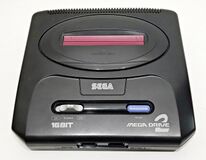
Japanese/Asian model

North American model
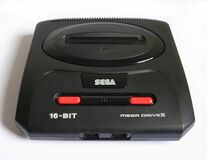
European model
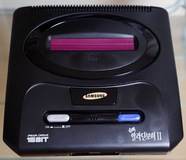
South Korean model


Genesis 3
- Main article: Genesis 3.

The Genesis 3 was a small version manufactured by Majesco in 1998 for the US market, which they had been manufacturing for until then. It is much smaller than its predecessors and lacks all expansions and fixes memory controller bugs — both rendering some games unplayable and the Sega CD and 32X unusable.
Portables: Mega Jet and Nomad
- Main articles: Sega Mega Jet and Sega Nomad.
The Mega Jet and Nomad were portable Mega Drive systems released near the middle/end of the system's lifetime. The Mega Jet, released in 1994, was originally designed for use on JAL airliners but was later released for Japanese consumers. The Mega Jet is a semi-portable system; the system has a built-in controller but requires an external power supply and a TV. The Nomad was a full portable in its own right, having an integrated screen and sound capabilities, in addition to a battery pack.
Arcade hardware: Mega Tech, Mega Play, and the System C
The Mega Drive hardware was adapted for arcade use several times over the course of its life. The Mega Tech and Mega Play allowed arcade operators to provide somewhat modified versions of popular Mega Drive games for arcade play — these systems use special cartridges containing games and players can choose from the games plugged into the system. The System C is a different board built from modified Mega Drive hardware, boasting improved color abilities and (in later revisions known collectively as the System C2) improved sample playback. The System C was primarily home to puzzle games — Columns and Puyo Puyo were released on this hardware.
Data East is also known to have licensed Mega Drive hardware for an arcade version of High Seas Havoc; not much is known about this board.
Mega-CD combos: JVC Wondermega/X'eye, Pioneer LaserActive, Sega Multi-Mega, and Aiwa Mega CD
- Main articles: Wondermega, LaserActive, Sega Multi-Mega, Aiwa Mega CD.
Combination Mega Drive/Mega-CD units were developed over the course of the Mega-CD's lifetime. The Wondermega and LaserActive are standalone consoles; the LaserActive also plays LaserDiscs. The Multi-Mega is a portable audio CD player that can play Mega Drive and Mega-CD games when plugged in to wall power and a TV. The Aiwa Mega CD is a Mega Drive/Mega-CD packed into Aiwa's consumer-level portable CD stereos.
Computer combinations: Sega Teradrive, Amstrad Mega PC, al-Alamiah units
- Main articles: Sega Teradrive, Amstrad Mega PC, Al-Alamiah AX-660, Al-Alamiah AX-990.
The Teradrive and Mega PC are combination Mega Drive/IBM-compatible PCs made for the Japanese and UK markets, respectively. The three Al-Alamiah computers are combination Mega Drive/MSX computers for the Arabic market.
Modern System-on-a-Chip compilations
A variety of companies now make licensed system-on-a-chip units in a variety of fashions that contain single-chip Mega Drive implementations and several licensed ROM images. TecToy-made SoaCs also contain several "new" MD games, however these are believed to be — and likely are — Java 2 Mobile Edition games running on additional hardware. For a full list of SoaCs, see the template at the bottom of the page.
Hardware revisions
- Main article: Sega Mega Drive/Hardware revisions.
Cartridges
- Main article: Sega Mega Drive cartridges.
Technical specifications
- Main article: Sega Mega Drive/Technical specifications.
Comparison
- Main article: Sega Mega Drive/Hardware comparison
It was the most powerful console at the time of its release in 1988, surpassing the PC Engine (TurboGrafx-16), and it was not surpassed in power until the Neo Geo in 1990. The Mega Drive is roughly comparable to its main rival, the SNES, released in 1990, with the Mega Drive having more raw processing power whereas the SNES has a larger color palette (see Sega Mega Drive/Hardware comparison (Super NES) article for a detailed technical comparison between the Mega Drive and SNES).
Compared to home computers at the time, it was not as powerful as the Japan-exclusive X68000 (released 1987) or FM Towns (released 1989). However, the Mega Drive was more powerful than Western home computers in the late '80s, including the Amiga.
History
- Main article: History of the Sega Mega Drive.
Localised names
| Language | Localised Name | English Translation |
|---|---|---|
| English (UK) | Sega Mega Drive | Sega Mega Drive |
| English (US) | Sega Genesis | Sega Genesis |
| Japanese | メガドライブ | Mega Drive |
| Korean | 수퍼겜보이, 수퍼알라딘 보이 | Super Gam*Boy, Super Aladdin Boy |
| Chinese (Simplified) | 劲锋壹號 | |
| Hebrew | מגה דרייב |
Games
- Main article: Sega Mega Drive games.

Production credits
Japanese version
- Team Leader: Masami Ishikawa
- Outer Casing: Mitsushige Shiraiwa[17]
- Hideki Sato
- Taku Matsubara
- Hiroyuki Ohtaka
- Spec Design of OPN2 / Sound Driver: Kazuhiko Nagai
Magazine articles
- Main article: Sega Mega Drive/Magazine articles.
Promotional material
- Main article: Sega Mega Drive/Promotional material.
Logos by regions
| Logo | Region |
|---|---|
| Used in Japan, Asia, Africa, parts of Eastern Europe and South Korea (from 1997) | |
| Used in North America and parts of South America | |
| Used in Brazil, Argentina, Paraguay and Uruguay | |
| Used in Western and Eastern Europe, Asia, Africa and Australasia | |
| Used in Asia | |
| Used in Scandinavia | |
| Used in South Korea (Super Gam*Boy) | |
| Used in South Korea (Super Aladdin Boy) |


![[11]](#cite_note-https:.2F.2Facervo.estadao.com.br.2Fpublicados.2F1990.2F11.2F22.2Fg.2F19901122-35513-nac-0081-eco-9-not-aaweass.jpg-11)
External links
References
- ↑ https://sega.jp/history/hard/megadrive/ (Wayback Machine: 2018-03-22 22:57)
- ↑ Computer & Video Games, "September 1990" (UK; 1990-08-16), page 13
- ↑ ACE, "October 1990" (UK; 1990-09-xx), page 51
- ↑ Micromanía (segunda época), "Octubre 1990" (ES; 1990-xx-xx), page 63
- ↑ 5.0 5.1 K, "Novembre 1990" (IT; 1990-xx-xx), page 21
- ↑ Video Club #20 page 23
- ↑ ABC, "Ročník 37, 16" (CZ; 1993-04-24), page 31
- ↑ Megazone, "August 1990" (AU; 1990-0x-xx), page 50
- ↑ Megazone, "November 1990" (AU; 1990-11-xx), page 25
- ↑ https://web.archive.org/web/20210622072008/https://techmonitor.ai/technology/sega_starts_test_marketing_new_machine
- ↑ https://acervo.estadao.com.br/publicados/1990/11/22/g/19901122-35513-nac-0081-eco-9-not-aaweass.jpg
- ↑ https://www.indiatoday.in/magazine/economy/story/19940430-shaw-wallace-to-manufacture-market-sega-tv-games-in-india-810502-1994-04-30 (Wayback Machine: 2020-06-21 19:35)
- ↑ https://www.youtube.com/watch?v=wqdN_L4YaDE#t=7m45
- ↑ Interview: Joe Miller (2013-02-07) by Sega-16
- ↑ Fourth generation of video games
- ↑ Press release: 1997-06-04: Sega Lowers Price on Hardware, Software
- ↑ https://www.kickstarter.com/projects/darrenwall/sega-mega-drive-genesis-collected-works-reprint
- ↑ https://www.famitsu.com/news/201308/12038274.html
- ↑ File:Sega_Consumer_History_JP_EnterBrain_Book.pdf, page 23
- ↑ Harmony, "1994 8" (JP; 1994-08-01), page 18
- ↑ https://www.facebook.com/hiroyuki.ohtaka/about_work_and_education
- ↑ https://sbtransr02.wixsite.com/kazuhiko-nagai/my-works-1

| Sega Home Video Game Systems | ||||||||||||||||||||||||||||
| 83 | 84 | 85 | 86 | 87 | 88 | 89 | 90 | 91 | 92 | 93 | 94 | 95 | 96 | 97 | 98 | 99 | 00 | 01 | 02 | 03 | 04 | 05 | 06 | 07 | 08 | 09 | 10 | 11 |
|---|---|---|---|---|---|---|---|---|---|---|---|---|---|---|---|---|---|---|---|---|---|---|---|---|---|---|---|---|
| SG-1000 | SG-1000 II | Mega Drive | Mega Drive II | |||||||||||||||||||||||||
| SC-3000 | Mega-CD | Mega-CD II | Genesis 3 | |||||||||||||||||||||||||
| Sega Mark III | 32X | Dreamcast | ||||||||||||||||||||||||||
| Master System | Master System II | |||||||||||||||||||||||||||
| AI Computer | Game Gear | |||||||||||||||||||||||||||
| Saturn | ||||||||||||||||||||||||||||
| Pico | Beena | |||||||||||||||||||||||||||
- JP Mega Drive hardware
- US Mega Drive hardware
- DE Mega Drive hardware
- ES Mega Drive hardware
- FR Mega Drive hardware
- NL Mega Drive hardware
- PT Mega Drive hardware
- UK Mega Drive hardware
- SI Mega Drive hardware
- SE Mega Drive hardware
- GR Mega Drive hardware
- IT Mega Drive hardware
- TR Mega Drive hardware
- CZ Mega Drive hardware
- PL Mega Drive hardware
- AU Mega Drive hardware
- NZ Mega Drive hardware
- MX Mega Drive hardware
- AR Mega Drive hardware
- E ×ternal JPEG reference
- External JPEG reference
- BR Mega Drive hardware
- CN Mega Drive hardware
- KR Mega Drive hardware
- RU Mega Drive hardware
- ZA Mega Drive hardware
- IN Mega Drive hardware
- Mega Drive hardware
- Bad external reference
- Credits without reference
- Sega Mega Drive